Your Custom Text Here
MiP Podcast + HiFi Reading Series Event Nov. 4th in NYC!
My Minorities in Publishing podcast has been asked to curate the upcoming HiFi Reading Series for November which is happening November 4th, 8pm at HiFi Bar in the East Village! Come here acclaimed author Daniel Jose Older and emerging artists Courtney Gillette, Glendaliz Camacho, and Ennis Smith read from their latest. Come for the booze & cupcakes, stay for the literature!

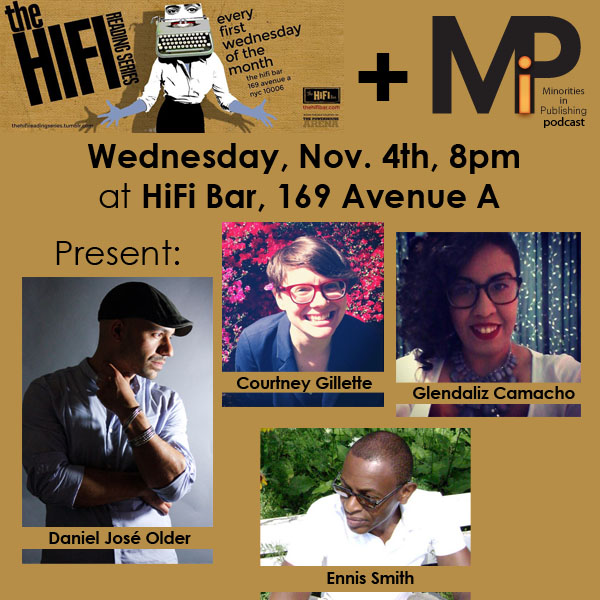 I am increasingly stoked about this reading happening tomorrow at HiFi Bar in the East Village! The Minorities in Publishing podcast was asked to curate the November reading for the HiFi Reading Series created by fellow writers & publishing professionals Lena Valencia & Ryan Britt. And I am honored not only to have been asked but to present these 4 generous, talented, and active artists in the industry.
Stop by for a drink, some smooth readings, and of course--because I'm me after all--cupcakes from Molly's Cupcakes! Reading starts at 8:15pm but get there early for seats!
Copies of Daniel José Older's critically-acclaimed fantasy Shadowshaper (Scholastic, 2015) will be available for sale thanks to PowerHouse Books and Daniel will happily sign copies.
Daniel José Older is the author of the acclaimed YA fantasy Shadowshaper with Scholastic Inc., a finalist for the 2015 Kirkus Prize and recently named by Publisher's Weekly as one of the Best Fantasy Books of 2015. He is also the author of the Bone Street Rumba urban fantasy series that began this year with Half-Resurrection Blues from Penguin’s Roc imprint. The next book in the series is Midnight Taxi Tango releasing in January 2016.Publishers Weekly hailed him as a “rising star of the genre” after the publication of his debut ghost noir collection, Salsa Nocturna. He co-edited the anthology Long Hidden: Speculative Fiction from the Margins of History and guest edited the music issue of Crossed Genres. Daniel’s work has appeared on Buzzfeed, The Guardian, and Huffington Post, among other publications.
Glendaliz Camacho is a Pushcart Prize nominee, 2015 Write A House Finalist, and currently a recipient of a Lower Manhattan Cultural Council Workspace residency. She has been an artist in residence at Jentel, Caldera, Kimmel Harding Nelson, and Hedgebrook. Glendaliz is a proud VONA Voices alum. Her work appears in The Female Complaint (Shade Mountain Press), Soulmate 101 and Other Essays on Love and Sex (Full Grown People) and All About Skin: Short Fiction by Women of Color (University of Wisconsin Press), as well as The Butter, Saraba Magazine, and Kweli Journal, among others. She is currently working on a short story collection and novel.
Courtney Gillette is an essayist and reviewer, reviewing books for Lambda Literary since 2010. She co-hosts The Hustle reading series, helps behind the scenes at BinderCon, and has served as a judge for the Lambda Literary Awards. In 2013, her work was chosen by A.M. Homes for The Masters Review, and nominated for a Pushcart Prize. She lives in Brooklyn with one bookseller and three cats.
Ennis Smith is a native of Cincinnati, Ohio. His work has been published inCreative Nonfiction Magazine, Ganymede, Mr. Beller’s Neighborhood, and the nonfiction anthology Lost and Found: Stories from New York (W.W. Norton). Other credits include Boys in the City (Bruno Gmunder Verlag GmbH), In Our Own Write, and dance and theater criticism in Attitude: The Dancer’s Magazine. He is a graduate of The New School’s graduate creative writing program.
Interview with Ennis Smith (A writer with a broad, creative range that stems from a long history in the arts.)
An interview with my friend and exceptional writer Ennis Smith who got his start in the arts from theater, which shows in the breadth and vividness of his writing.
I've known Ennis Smith for almost a decade now. He and I were in the New School MFA program at the same time. He for non-fiction and me for fiction. We both had a couple seminar classes together and were some of the few writers of color in the program. While I wasn't exposed to Ennis's writing directly since we didn't have workshops together I was drawn to him because of his intelligence, easy-going nature, lively attitude, and way with description whenever we entered a class discussion on some of the texts on the syllabus. Ennis and I remained in touch after we graduated and that grew as not only friendship but also critique partners. We regularly exchange work and have brunch with fellow writers and friends in Chelsea.
I was particularly glad that Ennis agreed to do an interview because his writing, as do many of my critique partners, always incites me to improve upon my own work. There's a level of humility with workshop mates where you gain fans for life and wonder "How the hell did they just do that?" Ennis has been instrumental in helping me improve my work and I definitely wanted to present more of his process to others. The memoir he's been working on is one of those texts I cannot wait for him to finish (and tell him this consistently). So I want people to be as jazzed about it and his writing and him as a person as I am.

~~~~~~~~~~~~~~~~~~~~~~~~~~~~~~~~~~~~~~~~~~~~~~~~~~~~~~~~~~
Why non-fiction? Perhaps that’s a weird question considering our work tends to guide us, but what aspect of this particular genre did you gravitate to to write your longterm project instead of fictionalizing it or writing it in bits as an epic poem? Perhaps the better question is, why do you want to write a memoir?
When I was a kid I identified strongly with Superman’s alter ego Clark Kent, to the extent that I used to pretend I was a newspaper reporter. I’d send my friends scurrying around the neighborhood to gather gossip, or anything that looked “suspicious.” In high school, I wrote movie reviews and features for the school newspaper—as a writer, as a person, I’ve always been interested in the known world, the things that surround us every day.
My memoir is about the death of a loved one, but it’s also about my situation in the world: people I’ve encountered, experiences that really branded me. I feel these things choose you, not the reverse. Someone suggested I fictionalize those events and my first thought was, “Why would I want to do that?” The “truth” is hard enough; beyond that I’m not interested in protecting myself, or muddying those waters of thought. I want more clarity, not less.
~~~~~~~~~~~~~~~~~~~~~~~~~~~~~~~~~~~~~~~~~~~~~~~~~~~~~~~~~~
What I’ve always admired in your writing is your knack for details, for setting the scene and the world around you so well that the reader is very much centered in it. They can see it. To me these details are your particular strength and something I learn from in terms of my lack of details of space. Have you always been in tune with your environment? If so, does it stem from your acting background?
There’s always a struggle to make sense of things for a reader, which is what I think the primary function of description is. But it’s also about an exploration, about how far you can go in terms of pinning down the experience of something. You learn to ask yourself those grad school questions, like: Is it visual? What does it sound like? Does it smell? But before that, I’m actually trying to pin it down for me. Later comes the playing with, the finding variety, and the search for some fresh terminology, which isn’t that much of an effort. Everyone has a frame of reference that’s distinctly their own—the trick is to be brave enough to share that with the reader.
~~~~~~~~~~~~~~~~~~~~~~~~~~~~~~~~~~~~~~~~~~~~~~~~~~~~~~~~~
In grad school you may remember there was a divide between genres, mainly in the workshop sense. Do you think this divide is necessary? Outside of the MFA environment and even conferences there tends to be the need to read as much as possible, to learn and gain inspiration and ideas from various avenues. Do you find that you get just as inspired by non-fiction as fiction and poetry or dance or visual art?
I feel the "how" of approaching those genres are, or should be the same. Give me interesting sentences. Give me wit—take those elements, be they made up, or reportorial, and tell me a story. I tend to think there’s nothing new under the sun: other writers have had to tackle the mechanics just as we are now. Models are good, they show us another way, or at least give us hope, that we will find the solutions to whatever writers wrestle with.
I remember one of our professors, Robert Polito, who emphasized the importance of cross-pollination. How is a written scene like a movie, for instance? Can you abstract a piece of writing like a painter? What every medium of art shares is the story it has to tell—it’s only the tools we use that are different. I try to see as much art as I can. I love theater and film, and I also read a lot. Aside from Shakespeare, poetry is the hole in my education I’ve been trying to patch; fiction is a particular pleasure, always has been, but it’s only been since grad school that I’ve tried to take writing apart and figure out how it works. I do it reluctantly, though, for fear it’ll ruin my experience of reading—it’s hard to surrender as a reader if you’re analyzing, and I enjoy giving myself up to a story.
~~~~~~~~~~~~~~~~~~~~~~~~~~~~~~~~~~~~~~~~~~~~~~~~~~~~~~~~~
What was it like for you to get your first acceptance for a piece and see it in published form? Did you feel legitimized in a way? Like, “Yes! I am a writer!” Were there tears of joy? Or a pressure to continue to produce? Sometimes I just have to reread some things that are in print or acceptances to residencies, especially after receiving rejections to know that someone does actually get what I do.
With the arts criticism I’ve written it wasn’t so much the pleasure of being published than it was that I was getting paid a tiny amount. I’m always thinking, “it could’ve been better,” so when something makes it into print it’s a happier experience for my family and friends than for me. The first time was unexpected: I submitted “The Super with the Toy Face” out of frustration because a writing teacher told me it was lacking. I didn’t expect it to wind up in a book. When you tinker with something too long, you start to feel as if you’ll never finish it, something I’m going through now. That was a lesson—sometimes others have issues with your work that have more to do with them than with what you’ve written.
~~~~~~~~~~~~~~~~~~~~~~~~~~~~~~~~~~~~~~~~~~~~~~~~~~~~~~~~~
Let’s talk about process. What’s yours? Is it sporadic? Consistent? Scheduled? Has it changed a lot over the years? For me it’s rarely ever as consistent as I’d like it to be. And I know for all of us working or seeking out work things can get even more convoluted when it comes to our art, an often unpaid venture.
Lately I feel I’m bouncing all over the place, because there’s so much I’d like to do. I have a big project I’ve been chasing for years, a memoir, and I go back and forth on it. But there are also smaller pieces I’d like to do. Part of it is feeling inspired—part of it is not wanting to sit down and work until you have a definite plan. I work best when I have a draft of something. Usually the ideas I want to explore are there in some form. It’s tragic—I can go weeks without laying anything down and feel tremendous guilt about it. And there are times when I can sit for days and hours with something, even if every word I type feels as if I’m going off the rails. I set deadlines, which sometimes helps, though not always. Schedules are hard for all of us—I’m teaching, so my students pull me away. Chasing paying work is another distraction that can’t be helped. I write when I can, even if it’s just notes about something I’m interested in.
~~~~~~~~~~~~~~~~~~~~~~~~~~~~~~~~~~~~~~~~~~~~~~~~~~~~~~~~~
Having lived in NYC there’s a sense, in your writing, that it’s home for you. Do you consider NYC, specifically Harlem, your home outside of your hometown in Ohio? Is NYC such a part of your work that you couldn’t imagine being anywhere else? Or are there times you long to leave here?
From the moment I sprang from the womb, I feel that I’ve been yearning for a place like NYC, or someplace like it. Especially growing up gay and in a family where you didn’t feel like your thoughts were validated, you wonder if they’ll be a time, a place in your life where it doesn’t feel like you’re constantly holding your breath. That was what the Midwest felt like—Sinclair Lewis nailed its peculiar sense of societal oppression, that pressure to conform, that’s still rife there. NYC kind of leads by example; you meet so many people and all of them are doing their own thing, which gives you permission to be yourself. It’s very much home, and even though I’ve lived here longer than I’ve lived anywhere, I’m still getting to know it; I love that I haven’t cracked it yet, that there are still discoveries to be made.
~~~~~~~~~~~~~~~~~~~~~~~~~~~~~~~~~~~~~~~~~~~~~~~~~~~~~~~~~
Your website focuses on many things, but often I notice the obituaries you post, specifically for figures in the arts be it in theater, film, dance. What strikes you to do these posts rather than focus on more personal items or use it as a journal like some may use an online platform for?
An undergrad professor who’d read some of what I’d written told me that as a writer my subject was loss. (No one had defined it before.) Even if I don’t sit with the intention of writing about loss, it always comes out that way, so I guess it’s an obsession of mine. As a former theater major, the course that impressed me the most was theater history. You found out about all these people who’d done it before, these innovators. It broke my heart that I’d never get to meet them and even now, a similar feeling occurs whenever I read the obits. I find out about people who’ve done amazing things, some of which have had a tremendous impact on our lives, and the first time I’m hearing about them is after they die. How whacked is that? It’s a selfish interest—my friends think I’m macabre. How is it that I find dead people’s lives more fascinating than those who are currently alive? I’m still working that out, but there’s an Armistad Maupin quote that moves me because it’s so true: “Missing people and wanting them back—that’s the price we pay for being alive.”
~~~~~~~~~~~~~~~~~~~~~~~~~~~~~~~~~~~~~~~~~~~~~~~~~~~~~~~~~
Thanks so much, Ennis, for the interview. See you at brunch soon!
A Word on Readings...
After discussing pros and cons of being an audience member at a reading I wanted to suggest three things to think about when you pursue reading your work to a larger audience.
A reading is a great way to get noticed and to build an audience. Spoken word artists rely heavily on the reception by an audience--it's in the title of "spoken word" artist that their work is crafted to be performed. And while there is material that is meant to be performed such as music and spoken word there's more subtle poetry, non-fiction, and fiction read aloud. My friend Kim and her friend Kia and I recently discussed bad readings we'd been to. Ones where the reader was monotone in the way they spoke, not changing inflection or diction at all for the piece. And when you have dense material this is very, very hard to listen to let alone get excited about. There are also those who tend to drag on and keep talking and talking because they have people there to listen. And when all these things combine it makes for a perfect storm in terms of the listening experience.
I've experienced the powerful and the painful. I've heard authors read large portions of work where only one sentence stuck with me after twenty minutes or more of listening to them. I've heard authors, published and non, ramble on about life coming to open mics with nothing prepared just hoping it'd flow, it didn't. I've also seen spoken word artists so in tune with their craft that they'll have a standing ovation and fiction/non-fiction authors arouse so much passion and sympathy from listeners that they just sold a good dozen or more copies of their books in the time they read.
Now, I'm not saying everything that is read should be humorous or fleeting and not necessarily be deep or have a connection. What I am saying is that a reader (author in this case) should consider their audience or potential and establish readers (those who do read the book). I think sometimes authors choose material that is the most interesting to them, but again that doesn't necessarily translate aloud.
My first experience reading aloud was in junior high and I was reading a portion from The Fear Street series by R. L. Stine. My mistake was that I read too long and without much oomph. When my classmates heard me rustle a page I heard groans in the audience, they were disgruntled at the fact that I kept going and didn't know when to stop. I went on so long that I bumped someone else out of a reading spot. In my sophomore year of high school I had written a poem for Black History Month and read it so stagnantly that no one paid attention to the words, no matter how 'deep' I thought they were in my adolescence.
By college I had learned a bit more, by grad school I was getting better and more animated, and now--while I don't know everything--I feel much more confident when I go to the mic to read my work. Am I nervous? Heck yeah I am! My hands shake the paper I'm holding so that I'm glad when I have a podium to hide my trembling. But because I believe in my work and the brevity and impact of it I know that even if it doesn't get a good response, it'll be over quickly enough.
My conference experiences attest to most of my recent experience in reading material I was confident in. Most if not all writing conferences with workshops as a focus will have an opportunity for participants to read from their work so that we're not only hearing faculty but the potential future of literature.
Material
My first time at VCFA I read a heart-rendering piece from my Collection that was really sad. It got shocked moans from the audience in places because they felt for the husband at the funeral. The piece has changed dramatically since then, but I knew the impact was there.
At Napa I had two minutes, and went a bit over, to reveal a scene about two men talking about infertility and insecurity, a tete a tete between two brothers. I chose the scene that revealed the most tension through dialogue. My workshop mates enjoyed it and Forrest Gander said he liked the opposition I presented in such a short amount of time.
At the Glen I read the last few pages of another story that my workshop mates and Sara Zarr had read. So I already had partial invested interest from people at the conference. The end was a fight scene. I got laughs in places I hadn't expected to and a nice round of applause. The next day at our farewell party several people came up to me and said they remembered my piece because of the power and tension and clear goal of the character in that portion. I picked it because I knew it was short and contained a moment that may resonate for readers and moved quickly, yet ended with heart for an edgy character.
I could've chosen the pieces that sounded pretty and I had been told 'moved' people and such but if the portion wasn't contained or wouldn't draw interest or couldn't succinctly tell a portion in an engaging way I more than likely won't read it out loud because I don't know if it'll hit the mark or if listeners will enjoy it enough to focus on what I'm saying.
Speech
Something else I've learned and gained control in is how I read. Like I said I started off very monotone with no inflection years ago. With my own writing I know the voices and the characters I have lived with for years, sometimes less. So I aim to capture those moments I want to convey. I can read pissed and lower my voice to a manly bravado.
My friend Ennis has done readings for pieces he's published. He's a former actor and really captures the range in the characters and moments. He's been complimented heavily for this and when he tells listeners he was an actor they aren't surprised.
Is it necessary, changing tones? No, but I think it helps to further show your range and understanding. I think going overboard with accents you cannot master may distract the listener rather than intrigue them. So I don't do southern accents for characters that have them, however I do alter tones when necessary and emphasize where necessary and get into the spirit like an actor would a part. These are your characters. This is your narrator. You know them best.
Length
I have to say that length and timing matter. Do practice reading if you have a time limit and the shorter the better at times. Jennifer Egan tends to read the same story, her first, from The Good Squad. I've seen her read a handful of times since it was released and she often reads that story because it does pack a punch, have interaction within it, and is one of the shorter ones in the collection. On top of that she reads it well. She knows Sasha and she does the voices of Sasha versus everyone and captures all the moments in the story so that after reading it yourself hearing her read it sounds completely new. And that's the effect you want to have on listeners.
I've read my flash fiction at conferences, open mics, and residencies and some pieces hit harder than others and required my audience for the few minutes I was in front of them to not have to pay attention for more than a few minutes. I appreciate the five minute limit because it does allow me to focus on a single moment to draw the reader in without going overboard with background and other instances that may not be of interest to listeners in that moment.
So these are my suggestions if you choose to read your work aloud:
1. Make sure the material will resonate with the reader and is conducive to being read aloud. If it's very convoluted and has a lot of twists and turns it may not be right for an audience to hear, especially if many are not used to listening to work.
2. Try to differentiate how you speak if you have dialogue and try to not sound too professional if the text doesn't require it. Junot Diaz writes in a voice that is similar to his own so that when he reads it's not as though he's reaching. Tayari Jones also is very good at capturing her characters when she reads. She knows them and hearing her read Silver Sparrow going from mother to daughter to father was amazing and put me in the moment. Like the writing the oral voice should be your own but reading it in one way every time may not give readers of your work a new experience.
3. Try to keep it short. Yeah, featured artists don't have that worry so much because they get a good amount of time. Usually twenty minutes or so, sometimes longer. But many people are not used to long periods of listening to something that is not accompanied by visuals and/or music. So if you're going to read for awhile make sure it works in that space of time as well, see 1 & 2 above.
I think these three things can help any artist whether it's doing a presentation or reading creatively. It's nice to hear your own voice but give the audience the respect of being entertained by it. It's not so much about you once you're at the mic but about those who graced you with their presence.
Artist Residency Withdrawal: Re-entering society after living the dream
Reacclimating myself with life post-residency. Not the easiest thing to do and it took weeks to retrieve the steady stride I had before I left. One cannot lose sight of what we do at a residency, but should also know that when you return to your element that you will have to get back into a routine if you want to be successful.
As I've stated many times on this blog and for those who know me in-person, heck random people on the street may have also been informed, that last month I returned from one of the greatest experiences of my life at the Jentel Artist Program Residency. June 13th marked the one month mark that I've been home and attempted to re-enter my everyday life in New York City. A couple weeks ago I met up with some writer friends who have and were about to embark on a residency. For Ennis his current time in Upstate New York serves as the longest that he's been away from the home he's made in Harlem. He asked my friend Kim and I for any advice as to how it is to be with other artists (and only other artists) as well as what he may look forward to (sarcasm!) when he returns.
Kim is a veteran in regards to residencies. She was the one who implored that I apply for them. She mentioned it was hard for her to re-immerse herself into life at work, especially when she returned during a really hectic time in the office.
Another friend of mine returned from her residency this year a few weeks before I left for mine. At present time she is still having a rough time of being back at work as a teacher and working on her novel preparing to send it out to agents. She's re-evaluating life after her residency and I'm sure is antsy to do another one.
Me, I just applied to another residency program for the beginning of 2012 and am lining up applications for more come the last quarter of this year. I believe the week of June 5th, a week before my LIU Summer Writers Lab workshop, I just got back to life and the productivity level I was at before I headed off to Jentel.
Let me try and summarize the first four weeks back:
Week 1: Reeling, and I mean reeling, from being home. I was picked up from the airport and I was glad to enter a clean apartment. Went food shopping and I got to eat some old faves, Chipotle & Dani's Pizza, before mentally preparing to return to work on Monday.
Returning to work entailed me having to deal with rush hour and wondering why I work in the first place. I kept comparing my surroundings to what I'd just left and found them extremely lackluster, especially my apartment which does not compare in scope to the large bathroom I had to myself at Jentel and the huge room, lovely open kitchen, and spaciousness, spaciousness, spaciousness.
In dealing with co-workers I was met with many who were happy about my return and excited about my experience. I also experienced a few who asked some arcane questions that I'm sure many artists in general cringe at. Ones like "If you're a writer, why do you work here?" "Oh, you're a writer what books have you published." "Oh, if you're a writer that means you've been published in The New Yorker?" And so on and so forth.
Week 2: Sorting through photos, updating the blog on my experience, and just sleeping and being lazy for the most part. I was not ready to be social with friends and pushed off many invitations to see people upon my return. I was lethargic and didn't cook, only re-heated, and didn't bake a lick. My usual routine of baking for people's birthdays in the office was non-existent and I just went from bakery to bakery to purchase goods I thought they'd like.
The upswing to this week was Book Expo which lead to attaining a lot of books, attending some book events, and standing a lot. But it was a good time!
Week 3: A friend's wedding and another work week. Mind you in these weeks that I'd been home I didn't do a lick of writing outside of e-mails and updating my blog. I wrote an article for Book Expo for AroundHarlem.com. I started reading a very good book that gave me a great amount of inspiration (see Goodreads list). I barely cleaned, leaving someone else to kindly pick up the slack when it came to sweeping and scrubbing the bathroom regularly. I hadn't done a full overhaul of the kitchen, usually my domain to clean, but couldn't muster the will to do so. I did start hanging out with friends more regularly, but still begged off some events and now had to worry about money since I wasn't saving as much by simply writing and staying in. I actually had to go out, look at my checkbook, and pay bills as well as for groceries and household needs again.
Week 4: Slowly getting back in the swing of things. I actually sat for a whole five+ hours to read and review all the stories I revised while away and started to make edits during my free time in the office. I attained some freelance work and did this as well. I made self-imposed deadlines for myself as well as submitting an application for a residency. I decided to enter some contests due at month's end and submit a YA piece for consideration. I'm also looking into revising pieces for a friend's anthology which is due by month's end. In addition to this I am starting other residency applications due in September, making contacts for references, and researching places to submit my more complete flash fiction pieces as well as compiling a list of places to hopefully submit a piece from my collection at the end of this year.
What helped during this time is having friends who've been through this. Fellow Jentelian Heidi Durrow was kind in asking how I was dealing with my return on Twitter and said she related but to give it time. This seemed to be the main piece of steady advice: just give yourself time to get back into the swing of things.
It took three weeks for this to happen but it did. During the fourth week I no longer looked at those on the subways as my enemies but as my equals just as I had prior to my leaving. I didn't look at work as a prison anymore, but a means to an end. I didn't think badly of those ignorant comments, though they still irritate me, of how I could be an artist when it wasn't how I was making my living. I got back into my routine and even tried to be more of a stickler to my craft by denying invites during the weekend so that I could stay home and focus and work. Whether it be on my own projects or ones assigned. I got back into cooking and just baked some blondies for a friend and the LIU SWL group.
At the Summer Writers Lab Akashic Publisher Johnny Temple said he was irritated with the thought that we should "just write." "With everything going on in the world" why would anyone feel a sense of "entitlement" at just writing. He was right. That's how I felt upon my return. That I was entitled to just be an artist and not have to work a full-time job or do freelance or do the work to make myself successful and support myself so that I could focus on my art. The dream is to make a living solely on our work because we enjoy doing it enough without pay, so how much more awesome would it be if we were getting paid. Well, that's not a reality for a crapload of artists.
I've come to terms with what I've been doing and look forward to the light at the end of the tunnel. It doesn't pain me to wake up and not see the vibrant colors of Neltje's decorated home. I'm up early and to bed early and slowly getting back into the swing of exercising regularly. I'm being kept awake by my work and have been blocking off time to work on it. It's been good these past few weeks and in giving myself the time to get there I feel reinvigorated to pursue my work.