BLOG
Interview with Ennis Smith (A writer with a broad, creative range that stems from a long history in the arts.)
An interview with my friend and exceptional writer Ennis Smith who got his start in the arts from theater, which shows in the breadth and vividness of his writing.
I've known Ennis Smith for almost a decade now. He and I were in the New School MFA program at the same time. He for non-fiction and me for fiction. We both had a couple seminar classes together and were some of the few writers of color in the program. While I wasn't exposed to Ennis's writing directly since we didn't have workshops together I was drawn to him because of his intelligence, easy-going nature, lively attitude, and way with description whenever we entered a class discussion on some of the texts on the syllabus. Ennis and I remained in touch after we graduated and that grew as not only friendship but also critique partners. We regularly exchange work and have brunch with fellow writers and friends in Chelsea.
I was particularly glad that Ennis agreed to do an interview because his writing, as do many of my critique partners, always incites me to improve upon my own work. There's a level of humility with workshop mates where you gain fans for life and wonder "How the hell did they just do that?" Ennis has been instrumental in helping me improve my work and I definitely wanted to present more of his process to others. The memoir he's been working on is one of those texts I cannot wait for him to finish (and tell him this consistently). So I want people to be as jazzed about it and his writing and him as a person as I am.

~~~~~~~~~~~~~~~~~~~~~~~~~~~~~~~~~~~~~~~~~~~~~~~~~~~~~~~~~~
Why non-fiction? Perhaps that’s a weird question considering our work tends to guide us, but what aspect of this particular genre did you gravitate to to write your longterm project instead of fictionalizing it or writing it in bits as an epic poem? Perhaps the better question is, why do you want to write a memoir?
When I was a kid I identified strongly with Superman’s alter ego Clark Kent, to the extent that I used to pretend I was a newspaper reporter. I’d send my friends scurrying around the neighborhood to gather gossip, or anything that looked “suspicious.” In high school, I wrote movie reviews and features for the school newspaper—as a writer, as a person, I’ve always been interested in the known world, the things that surround us every day.
My memoir is about the death of a loved one, but it’s also about my situation in the world: people I’ve encountered, experiences that really branded me. I feel these things choose you, not the reverse. Someone suggested I fictionalize those events and my first thought was, “Why would I want to do that?” The “truth” is hard enough; beyond that I’m not interested in protecting myself, or muddying those waters of thought. I want more clarity, not less.
~~~~~~~~~~~~~~~~~~~~~~~~~~~~~~~~~~~~~~~~~~~~~~~~~~~~~~~~~~
What I’ve always admired in your writing is your knack for details, for setting the scene and the world around you so well that the reader is very much centered in it. They can see it. To me these details are your particular strength and something I learn from in terms of my lack of details of space. Have you always been in tune with your environment? If so, does it stem from your acting background?
There’s always a struggle to make sense of things for a reader, which is what I think the primary function of description is. But it’s also about an exploration, about how far you can go in terms of pinning down the experience of something. You learn to ask yourself those grad school questions, like: Is it visual? What does it sound like? Does it smell? But before that, I’m actually trying to pin it down for me. Later comes the playing with, the finding variety, and the search for some fresh terminology, which isn’t that much of an effort. Everyone has a frame of reference that’s distinctly their own—the trick is to be brave enough to share that with the reader.
~~~~~~~~~~~~~~~~~~~~~~~~~~~~~~~~~~~~~~~~~~~~~~~~~~~~~~~~~
In grad school you may remember there was a divide between genres, mainly in the workshop sense. Do you think this divide is necessary? Outside of the MFA environment and even conferences there tends to be the need to read as much as possible, to learn and gain inspiration and ideas from various avenues. Do you find that you get just as inspired by non-fiction as fiction and poetry or dance or visual art?
I feel the "how" of approaching those genres are, or should be the same. Give me interesting sentences. Give me wit—take those elements, be they made up, or reportorial, and tell me a story. I tend to think there’s nothing new under the sun: other writers have had to tackle the mechanics just as we are now. Models are good, they show us another way, or at least give us hope, that we will find the solutions to whatever writers wrestle with.
I remember one of our professors, Robert Polito, who emphasized the importance of cross-pollination. How is a written scene like a movie, for instance? Can you abstract a piece of writing like a painter? What every medium of art shares is the story it has to tell—it’s only the tools we use that are different. I try to see as much art as I can. I love theater and film, and I also read a lot. Aside from Shakespeare, poetry is the hole in my education I’ve been trying to patch; fiction is a particular pleasure, always has been, but it’s only been since grad school that I’ve tried to take writing apart and figure out how it works. I do it reluctantly, though, for fear it’ll ruin my experience of reading—it’s hard to surrender as a reader if you’re analyzing, and I enjoy giving myself up to a story.
~~~~~~~~~~~~~~~~~~~~~~~~~~~~~~~~~~~~~~~~~~~~~~~~~~~~~~~~~
What was it like for you to get your first acceptance for a piece and see it in published form? Did you feel legitimized in a way? Like, “Yes! I am a writer!” Were there tears of joy? Or a pressure to continue to produce? Sometimes I just have to reread some things that are in print or acceptances to residencies, especially after receiving rejections to know that someone does actually get what I do.
With the arts criticism I’ve written it wasn’t so much the pleasure of being published than it was that I was getting paid a tiny amount. I’m always thinking, “it could’ve been better,” so when something makes it into print it’s a happier experience for my family and friends than for me. The first time was unexpected: I submitted “The Super with the Toy Face” out of frustration because a writing teacher told me it was lacking. I didn’t expect it to wind up in a book. When you tinker with something too long, you start to feel as if you’ll never finish it, something I’m going through now. That was a lesson—sometimes others have issues with your work that have more to do with them than with what you’ve written.
~~~~~~~~~~~~~~~~~~~~~~~~~~~~~~~~~~~~~~~~~~~~~~~~~~~~~~~~~
Let’s talk about process. What’s yours? Is it sporadic? Consistent? Scheduled? Has it changed a lot over the years? For me it’s rarely ever as consistent as I’d like it to be. And I know for all of us working or seeking out work things can get even more convoluted when it comes to our art, an often unpaid venture.
Lately I feel I’m bouncing all over the place, because there’s so much I’d like to do. I have a big project I’ve been chasing for years, a memoir, and I go back and forth on it. But there are also smaller pieces I’d like to do. Part of it is feeling inspired—part of it is not wanting to sit down and work until you have a definite plan. I work best when I have a draft of something. Usually the ideas I want to explore are there in some form. It’s tragic—I can go weeks without laying anything down and feel tremendous guilt about it. And there are times when I can sit for days and hours with something, even if every word I type feels as if I’m going off the rails. I set deadlines, which sometimes helps, though not always. Schedules are hard for all of us—I’m teaching, so my students pull me away. Chasing paying work is another distraction that can’t be helped. I write when I can, even if it’s just notes about something I’m interested in.
~~~~~~~~~~~~~~~~~~~~~~~~~~~~~~~~~~~~~~~~~~~~~~~~~~~~~~~~~
Having lived in NYC there’s a sense, in your writing, that it’s home for you. Do you consider NYC, specifically Harlem, your home outside of your hometown in Ohio? Is NYC such a part of your work that you couldn’t imagine being anywhere else? Or are there times you long to leave here?
From the moment I sprang from the womb, I feel that I’ve been yearning for a place like NYC, or someplace like it. Especially growing up gay and in a family where you didn’t feel like your thoughts were validated, you wonder if they’ll be a time, a place in your life where it doesn’t feel like you’re constantly holding your breath. That was what the Midwest felt like—Sinclair Lewis nailed its peculiar sense of societal oppression, that pressure to conform, that’s still rife there. NYC kind of leads by example; you meet so many people and all of them are doing their own thing, which gives you permission to be yourself. It’s very much home, and even though I’ve lived here longer than I’ve lived anywhere, I’m still getting to know it; I love that I haven’t cracked it yet, that there are still discoveries to be made.
~~~~~~~~~~~~~~~~~~~~~~~~~~~~~~~~~~~~~~~~~~~~~~~~~~~~~~~~~
Your website focuses on many things, but often I notice the obituaries you post, specifically for figures in the arts be it in theater, film, dance. What strikes you to do these posts rather than focus on more personal items or use it as a journal like some may use an online platform for?
An undergrad professor who’d read some of what I’d written told me that as a writer my subject was loss. (No one had defined it before.) Even if I don’t sit with the intention of writing about loss, it always comes out that way, so I guess it’s an obsession of mine. As a former theater major, the course that impressed me the most was theater history. You found out about all these people who’d done it before, these innovators. It broke my heart that I’d never get to meet them and even now, a similar feeling occurs whenever I read the obits. I find out about people who’ve done amazing things, some of which have had a tremendous impact on our lives, and the first time I’m hearing about them is after they die. How whacked is that? It’s a selfish interest—my friends think I’m macabre. How is it that I find dead people’s lives more fascinating than those who are currently alive? I’m still working that out, but there’s an Armistad Maupin quote that moves me because it’s so true: “Missing people and wanting them back—that’s the price we pay for being alive.”
~~~~~~~~~~~~~~~~~~~~~~~~~~~~~~~~~~~~~~~~~~~~~~~~~~~~~~~~~
Thanks so much, Ennis, for the interview. See you at brunch soon!
My NYC Midnight Submission, 1st Round (Flash Fiction)
Here's my 1st round entry for this year's NYC Midnight Flash Fiction Challenge. Is it action/adventure-y enough for ya?
As mentioned in my previous post this past weekend the first round of the NYC Midnight Flash Fiction Competition commenced. And it was 48-hours of craziness. Though the Twitter-verse wasn't as rowdy as usual. Perhaps because of the condensed time and the fact that there are only two more episodes of Breaking Bad left! Priorities. Anywho, for the first round my genre was Action/Adventure, my location was a Castle (which completely threw me as I never write about castles--you can thank Disney for that), and my object was a Bucket.
This was my first idea and it stuck. Don't love it but I think I hit all my bases. And of course it's after you hit the send/post button that you start seeing holes. Augh. Ah well. Thoughts/comments welcome.
I present Ascent:
You were always the favorite.
“That’s not true, Jeremy” Mia mumbles to herself, gulping air as she runs up the stairs. Her lungs feel like they’ll burst. Both her legs start to get that jelly feel as she ascends. In the darkness, each heel on a cobblestone step feels like a badge of honor.
Mia’s side brushes against the railing sending a flame from her right. The burn and stink of torched skin and hair are abundant. Jumping up another step she sucks in a scream, not wanting to hear her pain echo. On the upside, the fire provides the only light she’s seen since she initiated her climb.
The temptation to dose her leg with water from the bucket she carries is thwarted by the knowledge of how important it will become. She tries not to have too much water slosh out.
Mia stumbles, a stone gives way. “Pay attention!” she yells at herself. Her hair sticks to her neck and her bare shoulders; her tank top adheres to her skin. The whole castle, well the ruin it’s become, is a puzzle. A puzzle designed to screw her royal. Her father said it was an artifact remade to push present-day soldiers to the brink, to build the best of the best in lieu of older methods. Another stone crumbles and falls screeching before it hits the ground reminding Mia of how far she doesn’t want to fall.
Don’t die.
“Yeah, Jeremy, I’m trying.”
When she said this to him Jeremy didn’t look so sure from his wheelchair. He was her older brother, tall, but no one could tell anymore since he was always seated. He’d made it so far too. Their father was highly opposed to the new methods of testing. But was confident his children would make it out, with a little wear & tear. Then Jeremy returned with broken limbs beyond repair, practically a pretzel. Others came back broken or not at all. The announcement that Mia would be next in line was when her father was found in his office. No note. No reasoning. Just legs dangling, his neck twisted by the cloth tied to a ceiling fan. Mia was glad she hadn’t seen him like that. It wasn’t the Miller way.
Her right leg tucks under her, another cobblestone loosens. Regaining her momentum Mia jerks to the side touching the brick railing, and that’s when something shiny enters her periphery.
Her mind is on Jeremy’s words when she hits the floor. Her chest jams against the stairs inciting a strangled cough. There’s wind against her back and the sound of clothing tearing. A chill hits her skin. Another sting turns into a burn. Craning her neck the pendulum swings back where it came from.
Her attention snaps to the bucket on the step below her, tilted and losing water every second she stares at it. She pushes herself forward avoiding gaps where she senses them.
The castle looked huge when she approached it. A crumbling structure decimated at the top by bombs with pillars and columns’ jagged edges shooting into the sky. She headed inside with no supplies. “You come into this world alone, you leave it alone,” was all she was told.
She wobbles. “Don’t touch anything but the bucket.”
Air gets harder to take in. Her body is an unwanted weight. And that damn bucket. Its rope handles dig into her palm. Water swishes around. She wants to take a drink, bathe in it, dab her wounds. But she can’t, she needs every bit she has.
Mia gulps tapping down the excitement when she feels the last step, the ground above it flattening under her. Her eyes have settled on the darkness. Her hearing and the cool air on her skin are so much more pervasive now.
They wanted me to fail. They’ll try the same for you.
“There’s always a way. I’ll make it. The Millers will be back on top.”
You’re way too hopeful. Just like Dad was.
“That’s a bad thing. Hope?”
Look where it got him.
The thinning of the air this high up. The sting on her back. The scorching throb on her calf. The overall ache of her legs causing her to tilt backwards almost losing her balance. The parch of her throat. All of it is designed for her to fail, like Jeremy said.
Even lifting the bucket makes her heave, like she’s been carrying a boulder instead of water. She readies it, slowly pouring with each step she takes. Each splash confirms there’s ground for her to continue going forward.
And then the splash stops. The droplets descend lower, revealing just what she thought: a gap in the path.
Her boots slip slightly from the wetness on the stones and she finds the edge.
Her legs are unreliable even bending she feels the tremble shake up through her spine.
A curse filters up through her throat along with a gurgle. She sucks back her fear, her anger, the mucus accumulating and spits. At first she hears nothing but the whistle of the wind up this high. And then there it is. Splat. Her saliva hitting the other end of the path.
She doesn’t know how many feet but if she could spit that far, she could jump it. She throws the bucket, hears it soar and bust on the other side.
Mia steps back, readies herself. Another breath, more burning. Running start and up she forces herself to think, to do. When she lands her knees crack against stone. Her face smacks a sharp edge and wetness lines her cheek.
Her arms automatically reach up to touch the barrier. The sear through the air alerts her too late. “Don’t touch the railing,” she reminds herself and in that same moment she’s met with ultimate darkness. The sharpness imbedding itself and the pain searing through her head is immediate.
Mia touches her eyes but is met with the feathery tip of darts. Once again, someone’s failed.
#NYCMidnight Flash Fiction Competition: Yup, I'm Back In It
After a bit of a hiatus I have entered the NYCMidnight 2013 Flash Fiction Competition. Wish me luck and that I get challenged up the wazoo.
After a year long hiatus in which I did not do as much writing as I liked and freelance consumed my life (kinda still does in a way with other things) I took a break from the NYCMidnight competitions to save some pennies and copyedit psychology supplements. Fun? Sure, why not. But, seeing as how the flash fiction challenge was coming in I decided to enter for the early deadline and will again be in it for at least two rounds in the flash fiction competition which commences tonight at exactly midnight.
So, my next post will be my entry in the first round and we'll see what I get in terms of genre, location, and object prompts. The last time I entered the flash fiction competition I got science fiction and horror along with some random a** objects (for the horror it was mouthwash). I got a higher rating on the horror, which I was not a fan of, than the science fiction one which I thought was amazing. Just goes to show you never know what the judges will like.
From the time I get my prompts I will have two days to complete the story and must submit by the end of the weekend (before midnight, specifically 11:59pm). After the first two rounds highest scores will advance to the third round and so on to the fourth.
Wish me luck! I always enjoy the NYCMidnight competitions for the camaraderie on Twitter (hair pulling, b****ing about genres, panicking galore) and have met some really cool people through the competition and read some amazing work. It's a fun twist at writing something outside your comfort zone and seeing what you're capable of. Having done the short story and flash fiction competitions before I've learned I can do romantic comedy and horror as well as other genres. Just because you write in one doesn't mean you have to be relegated to it. If your aim is to write a good story that'll come through.
Good luck to all who do the competition and I look forward to reading your pieces and complaining about mine on Twitter right along with you.
FYI: Authors Read Reviews, Too
After hanging out with pubbed authors at conferences and residencies my mind and my method of critiquing has changed to be more considerate of the author.
The saying "do unto others..." is apt in many aspects of life, especially in terms of the book review, or really any kind of review of someone's art. As an artist, it's a sensitive thing to share your work, period. And once it's acquired by only an agent but a publisher, let alone a literary journal or on your blog or in a forum, there's a certain anxiety--as I've been told--about it being out in the much larger world. Yes, publication and exposure is the dream and ultimate goal for most artists, but once it's about to happen it can be a nerve-wracking experience.
No longer is your work within the boundaries of those you trust in a critique group, or with family, or whomever you may share your work with. It is now going out into the world. Freaking. Terrifying.
From the reader's perspective, when you read a book you want to be enthralled by it and sucked into the world and people the writer created or is reporting on. And when you are disappointed by a book you were excited about reading or that was highly recommended does not meet your expectations you may get upset. You may want to rant. And as we all know the internet allows people, in anonymity or not, to just shout out things that may or may not be kind.
I know I've ranted about award-winning books that I did not like. Not thinking about what I was saying but just saying it, at length.
Well, as an artist and as someone who has met with and is friends with published authors that method of review has changed a bit. I am more cautious when writing reviews, mainly sticking to a simple rating system (stars, half stars, what-have-you) and limited explanation.
What struck me about being more cautious about my reviews was in going on residency with authors who've had best-sellers and being in conferences with them as well. Befriending them outside of the conferences, residencies, and learning their own concerns and insecurities whether they've written a few dozen books or won an award or were on the New York Times best-seller list.
First off, authors do read reviews. Not all, and not every review. But authors do tend to read them. They go to Amazon. They go to Goodreads. They read the magazines and journals. They may even Google themselves. We've heard about high-profile authors such as Anne Rice and Stephenie Meyers going crazy when getting negative reviews of their work. Cursing people out in the case of Rice and just ceasing to share their work in the case of Meyers. So yeah, authors read reviews, not just the good ones forwarded onto them. And even with millions in the bank or many copies sold not everyone loves any one book. Not everyone loves The Hunger Games series or Harry Potter or Gone Girl or The Brief Wonderous Life of Oscar Wao. But we should be respectful of the fact that these pieces of art exist. And while we should be able to say how we feel. It's free speech after all! Going out to just ridicule the author for the sake of ridicule is not cool.
I've sat with authors who have been bummed that someone thought their non-fiction piece was contrived and strongly disliked the narrator (albeit the writer). I've met authors who had people cut them a new one in reviews online pulling down a rating for a book they worked very hard on just because they "didn't get it" or there wasn't a "happy ending." I've talked with authors who have said that a reviewer said she wanted to "kill herself" after reading her work because it was so depressing. And while this doesn't stop them from writing, it does hit a chord. It is surprising to them that someone would say something so mean, so bluntly, and so rudely about their work and by extension they felt them as people. No one seeks to create bad work. They want to write and create something for a larger audience and hope it reaches that audience. We seek to find a bond between artist and viewer.Sometimes it works. Sometimes it doesn't. But in the review it should be clearly defined and tactfully done.
Even something as highly sought as the NYT book review can be a bit acidic in tone. Roxane Gay writes reviews on Goodreads and keeps it short, sweet, and succinct feeling more filling than a long diatribe by someone who hated a book. So, yes, it can be done.
For me, I wrote some vitriolic reviews and went back to edit those down. Yes, they read well and are interesting and if someone agrees with you can acquire a lot of 'likes.' But in the end if the author read it, if it were about you, how would you feel? Since meeting with these authors I've toned down my vitriol. Do I like everything I read? Of course not. And as of late have gone through a bit of a slump in books of not being in love with anything I've read for over a month, sadly. But I take a step back and either simply give it a low rating with no explanation or explain in as short a away as possible like "didn't connect with the characters" or "plot seemed contrived" and leave it at that or additionally note that I enjoyed something else that the author did in the work or am a fan of the author themselves.
Am I saying all reviews should be watered down? No, because that would limit the variety of reviews and also the voice of reviewers. I'm saying that what I have learned in my reviews is not to be antagonist or rude or hateful for the sake of saying it, but that I can clearly state my reasons for disliking a book in a specific way that actually would help a potential reader understand my perspective and maybe affect their own. This is why reviews exist, to help people make a decision. I'm much more likely to read a book from a person whose reviews I enjoy and opinion I trust than someone who just went on a rant. (Though I do enjoy some of those reviews in gif form.)
And with that, go forth and read, peeps!
A Chat with Amy Christine Parker and GATED Giveaway
I had a "convo" with my critique partner and friend and all around good person, Amy, now that her debut GATED is about to hit shelves. This is so exciting and I wanted to have a kind of discussion with Amy about how our CP relationship came to fruition as she wrote GATED.
You may recognize Amy's name from my post last year thanking my YA critique partners (CPs). But more than likely you recognize Amy Christine Parker's name because her suspense YA debut GATED is due out from Penguin Random House next week and has been getting great reviews in Publishers Weekly and Kirkus. Yay, Amy! Amy and I met on WriteOnCon via a kind of "match up" where you read someone's synopsis on a forum, requested to see more, and then you switched work. If you liked each others writing and found the feedback was helpful BOOM you had yourself a connection. Amy was one of the first people I connected with and I am so, so very thankful for that.
JENN: So, what stuck out to me about Gated was the first line (Shoot to kill, okay) What?!? I was all over it as soon as I read it. And then I kept reading it and you sorted out concerns that we had discussed and perhaps you discussed with Krystalyn and Stefanie as well but what I admired (what I additionally admired) was that you were able to zero in on this stuff and get it done so fast!
AMY: I remember when we met thinking that I loved the way you critiqued. You were just the queen of finding all my inconsistencies. I was beyond excited that I was able to snatch you up! And thanks for thinking that I’m compartmentalizing so well!
JENN: You compartmentalize your time not just as a writer but as a reviewer as well. As a full-time mom and writer and doing everything you do from participating in activities with your kids/their school and reading others work and trying to find time for yourself and your husband it can be so much. That balance is crucial.
AMY: Truth be told I think I spend most days juggling everything like mad and hoping I don’t drop too many balls. Balance isn’t really achieved so much as I make my writing a priority no matter what. I wanted to be a writer--specifically a published writer--so badly that I literally let go of every unnecessary chore/obligation/frivolous time wasting thing that I could. My house is rarely entirely clean. My kids eat takeout just about as often as they get a home cooked meal. The laundry piles up. The balance thing is an ongoing goal I hope to one day come close to achieving. But even if I never do, I’m happy because I’m doing something that I love every single day and my family is happy because I’m much better at being a mom and wife now that I’ve allowed myself to go after my dreams.
JENN: I also realized when reading Gated how specific and unique the story was. This was a story that wasn't being told and could actually happen which upped the creep factor exponentially and it's telling as well that Penguin Random House has so much faith in the story itself but also your writing. Perhaps as writers we kind of zero in on what scares us because there's an internal thrill to it that we can control. When I was a kid my mom had A LOT of Stephen King books. So I read that. And I got into R.L. Stine from there and read some Anne Rice as a teen. I was growing out of BSC and Sweet Valley High/University to reading The Stand. So my mom's taste definitely influenced my own for awhile as I was growing up and lead to me writing this horror story I wrote in high school called "Terror at Bowne." I even did a sequel.
AMY: Stephen King was huge for me growing up, especially his short stories. I was a fairly shy kid and spent tons of time hiding out in the library at school. Uncle Stevie’s books were the ones I pulled off the shelves to keep me company. The short stories were perfect because I could devour them in one library session. To this day, his short stories are what have stuck with me most out of all that I read as a kid and probably had the biggest influence on what I choose to write now. Although...there were also these creepy story records I used to listen to with my cousins when I was really little (yes, I am that old, I had vinyl records AND 8 track tapes). I forget almost everything about the stories on those records, but I will never forget the sounds and the tone of the people’s voices as they told the stories. It made my hair stand on end and afterwards I would have the worst time sleeping. After every “up all night” session I had I’d swear off listening to them, but then I could never actually make myself do that and before long I’d be listening to them all over again. Scary stories have always, always been my favorites which is funny I guess, because my mom is much more of a sci fi/fantasy reader who likes things to stay light. When I tell her my latest ideas, she’s always a little freaked out! She’s wondered out loud more than once where my fascination comes from. I think for me it isn’t so much a thrill I can control, but more of a way of explaining evil and how it works to my readers and maybe most often, to myself. I think on some level maybe I’m looking to understand it so I can see it coming in people or situations and avoid it...but really, on the surface I think it’s mainly that I find scaring and being scared to be a lot of fun!
THE GIVEAWAY
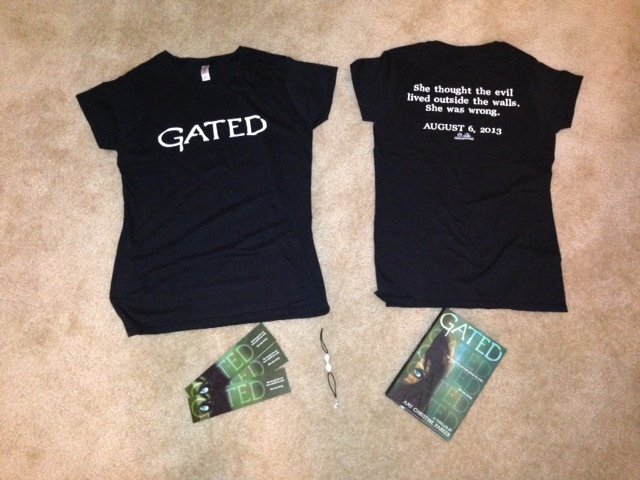
Amy is being super generous by offering up a GATED prize pack with her debut's release! See the pictures of the items below. Ohhh. Ahhh.