Your Custom Text Here
"Coming to America": A Classic Piece of African-American Cinema
In watching "Coming to America" again as an adult I was able to appreciate the nuances of characters and plot development, something, when looking at current African-American films, is often lost on the screen. In the midst of all the genres of film and in looking back at how original African-American film was only ten or twenty years ago, it's amazing to find that so few films are original, daring, and intune with society or smart enough to know how to mock it.
Yesterday, my talented writer friend Kim invited me along as her guest to another talented writer's birthday party. Tiphanie Yanique's birthday was a nice celebration in Clinton Hill, Brooklyn at a lovely African restaurant that provided the entire back room for her celebration.After dining on some lovely Senegalese food and massive pieces of equally delicious red velvet cake with Tiphanie's face on it, we got to enjoy a movie projected on a white screen hosted by QUE Films. While a QUE Films original was set to air the men behind the project decided on lighter fare. So, we saw Coming to America, one of Eddie Murphy's more successful films and, to me, one of the best African-American films of the past twenty years.
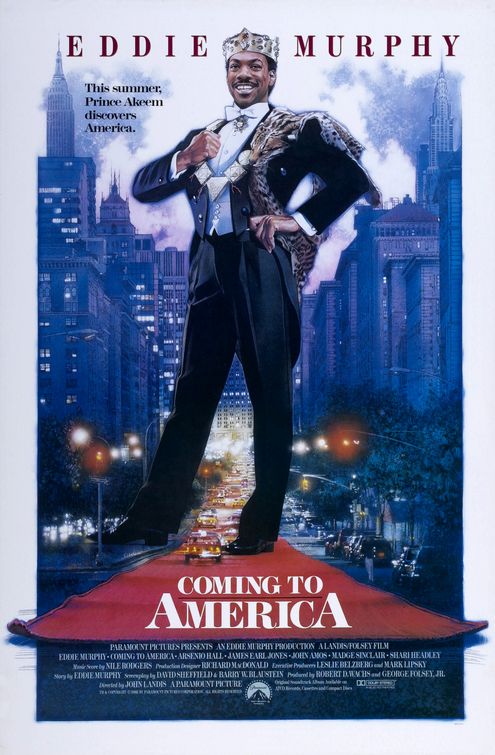
It was funny that a conversation Kim, me, and another poet we met at PALF had was that when seeing things later in life you interpret them differently. I have maintained that I enjoyed and understood Huckleberry Finn in graduate school more so than I did in High School and the opposite can be said for my take on Catcher in the Rye. But in watching Coming to America again, years after I'd viewed it before and many years after I originally saw it cut/dubbed on television I saw a lot of what Murphy was attempting to portray in Black America and what he made riffs on (the story was originated by Murphy while the screenplay was written by David Sheffield and Barry Blaustein).
Coming to America was released when I was seven years old, in the summer of 1988. Eddie Murphy was riding the wave of being the most influential and powerful African-American actor of his time and was coming off a string of hits such as Trading Places and Beverly Hills Cop after having been a central and popular player on Saturday Night Live. In Coming to America one of Murphy's key talents (impersonation) is shown throughout the film in energetic and hilarious characters. Murphy has always had a talent for getting into different characters and adopting mannerisms and voices and we've seen this in several movies of his (including The Nutty Professor and Norbit).
When looking at the kinds of African-American films that are currently released you can pretty much put them into a few of categories: Caricature Comedies (see: Soul Plane, Lottery Ticket, The Cookout, many Tyler Perry movies, etc.) where Black people are played as the over-the-top stereotypes they're supposed to be showing their varied enough not to be, Crime/Action (see: Dead Presidents, Belly, Cradle to the Grave) where a Black celebrity (many times a rapper seeking to cross over) will do a quick action flick with someone who is a staple in this genre (see: Steven Seagal, Jet Li) and make a few bucks at the box office. But then you also have Inspirational movies (see: The Gospel, Tyler Perry movies), Independent Dramas that don't always get the recognition they should for being so versatile and intriguing (see: Eve's Bayou, Precious), some Family Friendly films (see: Roll Bounce, Johnson Family Vacation, College Road Trip, etc.), a few Musicals (see: Dreamgirls), and of course we can't forget the wonderful, and not so wonderful, Biopics (see: What's Love Got to Do With it, Malcom X, Ali, Get Rich or Die Trying, etc.). Something like Hard-hitting films mainly refer to films of the past that were ahead of their time like Boyz n' the Hood, Straight Outta Brooklyn, or Spike Lee's earlier work (Do the Right Thing, Crooklyn, Mo Better Blues),
In the midst of all these genres and in looking back at how original African-American film was only ten or twenty years ago, it's amazing to find that so few films are original, daring, and intune with society or smart enough to know how to mock it.
The popularity of Tyler Perry films have a formula: Woman is scorned by evil man and is destitute for part or much of the film, finds a wonderful man in the least of all places, and boom finds strength in herself as well as the ability to trust/love again. It's a formula that works and it's one in which Black women do not see themselves often portrayed on the big screen. So, Perry has found his niche. He's the man writing for women and women love him and men think he's pretty darn funny when he wants to be, especially as Madea. Perry isn't necessarily taking cultural norms and turning them on its head, he's taking cultural norms and consistently providing the audience with a happy outcome, no matter what (though I heard there was some tragedy in the sequel to Why Did I Get Married? daring him to go against type for just a bit on-screen).
When looking at other recent films with Black actors at the center they are either part of a mixed cast or the token person of color (see: Denzel Washington who can pretty much play and do whatever he wants in Hollywood as well as Halle Berry who is attractive enough to do whatever she wants in films) or if the cast is largely Black then they are an all-stars (Lottery Ticket, Death at a Funeral) to ensure high traffic at theaters, yet not necessarily guaranteeing a solid story and/or script or is an Independent film you may not hear about unless Oprah backs it or funded it herself (see: Beloved, Precious) and then there are many other films by Black female directors you may never hear of again or ever, one of my favorites is Kasi Lemmons). 
So what's my point? Well, in looking back at Coming to America I realized how different it was in a time when African-Americans didn't have a lot of control over the images they played. In this film Eddie Murphy made Africa look superior to America! A rich prince with wealth beyond his dreams, flower bearers, people looking after him in every-which-way and attending to his every needs was unhappy, even though he had jungle animals roaming through his front yard and fresh fruit galore! When he comes to Queens, NY to find a bride he is surrounded by filth, destitution, and a lot of expletives, yet he has never been more content in his life. His cohort is played by Arsenio Hall, a man so pampered he finds everything appalling as his comrade finds things to be so wonderful and new. The audience may be relating more with Hall initially, but eventually finds that they sympathize with Murphy's character. Murphy's Prince Akeem is the flipside of Cinderella, the prince seeking the fair maiden and having nothing to go one but his wits and instincts, having to trump jeri curled boyfriends and nitpicky fathers and a lustful sister. This film could've been done with an all White cast. I could see Matthew Broderick or Matt Dillon fighting over the part of Prince Akeem, though he'd be named Prince Albert back in the late 1980s. Instead of going to the slums of Queens, they may have resided in Manhattan and attempted to understand the subway system and other "quaint" American customs. But that's another film all together and wouldn't have been as relatable, at least to me as an African-American female, as Murphy's film was.
Coming to America mocks Black culture, but also embraces it. The four men in the barbershop (two played by Murphy and one by Arsenio Hall) are the best in cinema! They argue about who's a better boxer and the state of the world today. They know the world as they've watched it go by them steadily and mock it day in and day out. Murphy shows that the father of his love interest is an entrepreneur wanting to make his fast food restaurant, McDowell's, as big as McDonald's! He has an African-American female who wants to do good for her community, while being good and finding good in other people. Coming to America shows characters that are a bit saucy like your local, sweaty preacher ogling girls in bikinis at the Black Awareness rally while preaching the Lord's name at the same time. Murphy's main character brings wealth and kindness to those that didn't receive it in the ghettos of Queens and is continually a better person for it.
Now, I'm not saying Coming to America is the end all/be all when it comes to African-America cinema. Yes, there are better films out there, but I think this is one of the best films by African-Americans for African-Americans and that there's been a steady decline in ones that make you realize how much is packed in and what the writers, actors, crew, and director are trying to convey. Coming to America is a coming of age story as well as a love story...with African-Americans in it! This movie shows that African-Americans are hard-working, sexual, intelligent, neurotic, egotistical, and kind. The characters played off characteristics we're familiar with as viewers, but made fleshed out characters for many of the people playing them. Yes, the preacher was a bit one note, but he was familiar. Sure, the jerky (jocky) boyfriend of the sweet girl reminded me of many of the jerk/jocks in John Hughes films, but he ended up getting his in the end and realizing that looks aren't everything. Yes, the prince was more spectacular than any woman could imagine, but he had his flaws and insecurities too when it came to finding love.
I think that when viewing a film where the majority of the cast/crew is African-American that we should really look and listen to what's going on on-screen and see how characters interact with each other and convey themselves. Eddie Murphy is a master of physical inflections and such as mentioned and he does a great job of showing how his characters feel. When was the last time you saw a film with African-Americans that made you really consider how much thought was put in behind the meaning of every nod, tear, embrace, kiss, etc? When was the last time you saw someone's face run the gamut in two minutes flat? When was the last time you saw a film that trumped your expectations with a Black cast? It's been a while, you say? Perhaps we should look back in the archives a bit and see what filmmakers were doing twenty plus years ago and urge the up-and-comers to follow the footsteps of finding the unpredictable in the predictable rather than recycling tired parodies solely for entertainment. There's nothing wrong with entertainment of course, but I think in the canon of Black film there should be more thought-provoking ones than ones that simply make you giggle.
"Outrage" over inequality and hypocrites
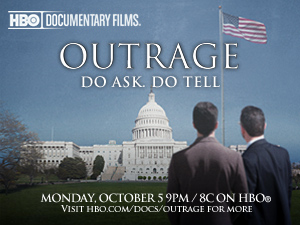 Early this month HBO premiered Kirby Dick's documentary on hypocrisy in government from politicians who boldly vote for anti-gay legislation while leading a closeted life as homosexuals. Outrage focuses on various politicians, many Republicans, who have been outed by members of the press, in particularly Blogactive.com founder Mike Rogers.
The outrage is over politicians who can be so strong in their convictions when it comes to voting against equal rights such as same-sex marriage, gays in the military, same-sex couples being able to adopt, AIDS/HIV funding, etc. yet have no problems with entering into a sexual relationship (be it NSA or long-term) with someone of the same sex. It boggles the mind of everyone who speaks on the matter as to how one can be so blatant when it comes to condemning a part of themselves and hiding it by living a "normal" life that is accepted among their conservative majority.
Politicians such as former Senator Larry Craig (Idaho), Representative Ed Shrock (Virginia), Jim McCrery (Louisiana), and David Dreier (California) are some of the people who have been outed on Blogactive.
Dreier is a "confirmed bachelor" who is potentially having a relationship with his chief of staff. Someone who is noted to travel with him to some exotic places.
Senator Craig may have entered into a marriage of convenience and spoke at length with Matt Lauer refuting any inkling of homosexuality in his being with his wife at his side. Both Mr. and Mrs. Craig state how ridiculous it would be to enter into a false marriage for the sole reason of helping boost his career in the Republican party.
McCrery is bashed by those who knew him way back when for having been an athiest and cursing the government for being immoral and not pushing through bills that would give gays and lesbians equal rights. McCrery has ads starring him and his wife urging voters to trust him as a man looking out for their best interest albeit denying his compromise of his liberal standards once he got backing from the Republican party and a church financially for his political career.
One of the most disturbing stories is the ongoing one of Florida Governor Charlie Crist who continually blocks gay & lesbian equality laws and openly states that he is against marriage that is not between a man and a woman. There's been many accounts of homosexual trysts that Crist has engaged in, but because he is currently in office (and more than likely has quite some pull) those who know the truth are not willing to go on record. Crist does not agree with same-sex couples adopting children in Florida even though a Florida judge ruled it unconstitutional. Crist has seated two judges onto the Florida Supreme Court who are highly opposed to same-sex marriages. Crist has been a bachelor for a very long time getting divorced about 30 years ago after six months of marriage. He recently wed a young woman last December and is currently looking to join the U.S. senate in 2010. His website states: "He proposed and worked to pass Florida's landmark civil rights legislation, the Marvin Davies Civil Rights Act of 2003, to pursue those who engage in willful discrimination against others." Seeing that he's an advocate for civil rights but not gay rights seems hypocritical in itself.
There are some interviews with politicians who have since come out and are very relieved to have done so. Democratic representative Barney Frank (Massachussetts) admits that it is a relief to not have to hide who he is or to try to act as a moderate when it comes to gay & lesbian rights for fear that someone will think he is one. Former representative Jim Kolbe (Arizona) came out in the 1990s after being threatened by an opponent that they'd out him. Kolbe's honesty turned out to be "the most lifting experience I ever had." And further to the point he stated that friend and fellow representative John McCain didn't care about his sexuality because he thought Kolbe a good politician further stating that he "was always gonna be my friend." Hearing such uplifting remarks one would hope that others would follow suit in not only coming out of the closet but for others to openly accept them for the person they are and not the bedfellows they choose.
Former NJ governor James McGreevey concurs in the fact that finally coming out of the closet relieved him of a huge burden in having to live a double life. McGreevey connected homosexuality with lewd and disgusting behavior because of the ways he hid it. Having sex in back alleys and at rest stops enforced a feeling of wrongness that wasn't true but that he couldn't come to grips with when he was younger. It's through support and education that McGreevey can see the reasons for his shame and acknowledge how much happier and better his life is now that he's being honest with everyone, including himself.
Taking a peek at the other side Dina Mattos McGreevey was interviewed with hostile feelings being evident in her stern speech and facial expressions. "What part of my marriage was real?" she asks, wishing that McGreevey's uncertainty hadn't lead them to the alter. The women that are hidden to the fact of their husband or fiance's conflicted feelings do become victims themselves of entering into a relationship that is based on falsities from the very start.
There are comments from those who've been fighting for gay & lesbian equality to those who hid their truth away for years before being able to come "clean," their stories relay intriguing and harrowing tales of how far gay & lesbian rights still has to go across the country. One commentor piggybacks Harvey Milk's statement that if everyone came out of the closet and accepted their truth then "we'd win." It's many people's hope that with a handful more U.S. States allowing same-sex marriages and other equal rights for gay & lesbian couples and individuals that sooner (rather than later) we'll see progress all over. Which means that there'll no longer be a reason for politicians and people alike to feel a need to hide or hate.