Your Custom Text Here
MiP Podcast + HiFi Reading Series Event Nov. 4th in NYC!
My Minorities in Publishing podcast has been asked to curate the upcoming HiFi Reading Series for November which is happening November 4th, 8pm at HiFi Bar in the East Village! Come here acclaimed author Daniel Jose Older and emerging artists Courtney Gillette, Glendaliz Camacho, and Ennis Smith read from their latest. Come for the booze & cupcakes, stay for the literature!

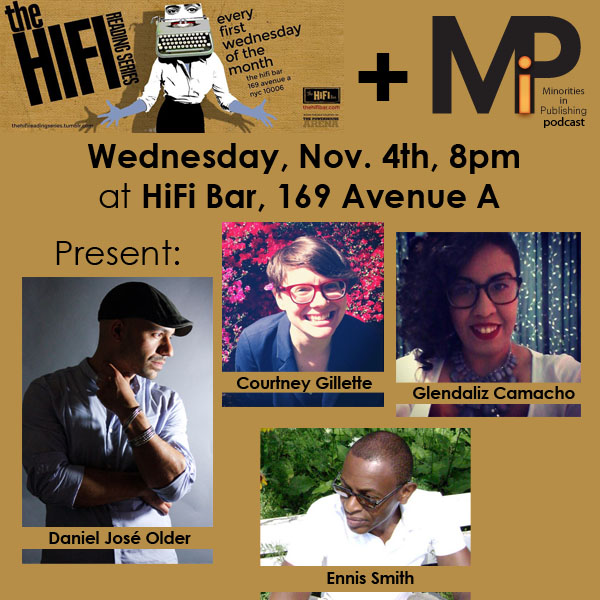 I am increasingly stoked about this reading happening tomorrow at HiFi Bar in the East Village! The Minorities in Publishing podcast was asked to curate the November reading for the HiFi Reading Series created by fellow writers & publishing professionals Lena Valencia & Ryan Britt. And I am honored not only to have been asked but to present these 4 generous, talented, and active artists in the industry.
Stop by for a drink, some smooth readings, and of course--because I'm me after all--cupcakes from Molly's Cupcakes! Reading starts at 8:15pm but get there early for seats!
Copies of Daniel José Older's critically-acclaimed fantasy Shadowshaper (Scholastic, 2015) will be available for sale thanks to PowerHouse Books and Daniel will happily sign copies.
Daniel José Older is the author of the acclaimed YA fantasy Shadowshaper with Scholastic Inc., a finalist for the 2015 Kirkus Prize and recently named by Publisher's Weekly as one of the Best Fantasy Books of 2015. He is also the author of the Bone Street Rumba urban fantasy series that began this year with Half-Resurrection Blues from Penguin’s Roc imprint. The next book in the series is Midnight Taxi Tango releasing in January 2016.Publishers Weekly hailed him as a “rising star of the genre” after the publication of his debut ghost noir collection, Salsa Nocturna. He co-edited the anthology Long Hidden: Speculative Fiction from the Margins of History and guest edited the music issue of Crossed Genres. Daniel’s work has appeared on Buzzfeed, The Guardian, and Huffington Post, among other publications.
Glendaliz Camacho is a Pushcart Prize nominee, 2015 Write A House Finalist, and currently a recipient of a Lower Manhattan Cultural Council Workspace residency. She has been an artist in residence at Jentel, Caldera, Kimmel Harding Nelson, and Hedgebrook. Glendaliz is a proud VONA Voices alum. Her work appears in The Female Complaint (Shade Mountain Press), Soulmate 101 and Other Essays on Love and Sex (Full Grown People) and All About Skin: Short Fiction by Women of Color (University of Wisconsin Press), as well as The Butter, Saraba Magazine, and Kweli Journal, among others. She is currently working on a short story collection and novel.
Courtney Gillette is an essayist and reviewer, reviewing books for Lambda Literary since 2010. She co-hosts The Hustle reading series, helps behind the scenes at BinderCon, and has served as a judge for the Lambda Literary Awards. In 2013, her work was chosen by A.M. Homes for The Masters Review, and nominated for a Pushcart Prize. She lives in Brooklyn with one bookseller and three cats.
Ennis Smith is a native of Cincinnati, Ohio. His work has been published inCreative Nonfiction Magazine, Ganymede, Mr. Beller’s Neighborhood, and the nonfiction anthology Lost and Found: Stories from New York (W.W. Norton). Other credits include Boys in the City (Bruno Gmunder Verlag GmbH), In Our Own Write, and dance and theater criticism in Attitude: The Dancer’s Magazine. He is a graduate of The New School’s graduate creative writing program.
#ArtistTherapy: Measuring "Success"
Last post for #ArtistTherapy! Thanks for sticking with me on these throughout the year and hope the words have been helpful as you continue your creative journeys. :-) Latest and last post is on the idea of success and what that means, or may mean, for you.
"I don't feel like I've accomplished anything..." Yes, it's that time of the year. End of year review, year in review, summation of goals, whatever you'd like to call it and you start to consider what have you actually done. Especially in terms of your art. Let's call it what it is: pity party time.
Every year I write a list of goals/aims for the next year. This is for me to be accountable and also seems a way to punish myself. I am a checklist person. Someone who needs to be able to scratch things off and then see what's next to tackle. The idea of taking items off a To Do list is nice. Makes me feel productive. But also when looking at the year-round results I see I didn't do as much as I aimed and also took on a bunch more than I'd envisioned.
And there in lies the rub. Events, activities, volunteer work, new ideas, heartbreak, and so on can sneak up on you and derail your goals completely. Yet, you're still accountable for what did and did not happen. And when it comes to your art did you pursue it as heavily as you swore you would on the last days of the year as the clock steadily ticked down to a new year, new month, an anticipated new life? Maybe not.
If the answer veers toward the negative do you consider yourself successful?
The measurements of success are so varied for so many people. I consider success doing what I said I was going to do and being satisfied with the final product. I also consider success getting something I believe in published at a place that understood my goal. I consider success someone enjoying a cookie I developed. I consider success finishing something, anything. I consider success being respected by my peers for what I do know and being open to additional knowledge. See? The scope is wide.
What I am taking away from 2014 are the things that have brought me a better understanding of myself and my work. I am glad for being a part of We Need Diverse Books, for starting a podcast to continue the lack of diversity in publishing/art conversation, I am hopeful that my latest draft of my collection will be done before 2015 is officially here. I am glad for the small wins and consistency of life in being employed. Still being passionate about my work. Having a continuous slew of ideas hit me. Of having my work celebrated with acceptance for a future publication or winning an award that allowed me free attendance to a conference that gave me renewed faith in my work. I am glad for the success of panels and cookie competitions I participated in and for being able to work on my writing even if I didn't make as much time as I had (continually) promised myself. I consider 2014 successful in some areas and not so much in others but that's what the culmination of days helps with. Making sure that you are building towards that bigger goal that overall feeling of success that may not be accomplished with crossing off a task in a day but more so the accumulation of knowledge and heart and passion for the work you are pursuing.
Maybe you want to make a Goal list for next year. Maybe you want to hold yourself accountable day to day. Maybe you want to engage in said pity party and sulk over the "lack" of success you had if there's no agent contract, no book deal, no show in the works. But consider that if you've made progress, that same forward movement we talked about earlier this year that was so easy to stay stagnant in that any steps could be considered a success because we're looking forward, not back.
The Diversity Debate
The lack of diversity in books specifically has had a snowball effect since BookCon's lack of White, straight, male authors on a panel that could've easily contained people of the non-majority. Since then more statistics and essays and posts and cries for diversity have been provided in print, online, and spoken about at conferences (not just in private discussions). The "debate" of diversity is not going away and that's a good thing.
There’s been a lot of discussion about the lack of diversity in art. In my world this pertains to books specifically. The discussion has risen and will not be curbing any time soon thanks to We Need Diverse BooksTM and also other entities focusing specifically on bringing more attention to diversity in books--meaning that there should and could be more non-majority main characters (not sidekicks) as well as more diverse writers. Last week Publishers Weekly revealed their 2014 salary survey for the publishing industry that included the option for those who participated to note their race. The results were staggering. Not only in the fact that many people approached did not respond but that of the several hundred who did the reflection of people of color was under 10% total, which seemed to set the online world on fire.
My friend Bev Rivero and I created the podcast Minorities in Publishing (MiP) because with our 20+ years in publishing we had always felt the lack of diversity in publishing. Working in it you cannot help but see it and it’s interesting to me that once the numbers were represented, be it a small portion of those approached in the industry, that more awareness came to light about why there may not be more diverse books being acquired, promoted, and sold. If there aren’t enough people of color (POC), LGBTQI, or disabled helping on the back end of bringing these books into a publishing house, developing a plan, and going on to find readers for this type of material (those without a true understanding of what it may be to be of the non-majority) how can we expect anyone to best stand by these books (and writers) to make work for a larger audience?
Being a team member of We Need Diverse BooksTM, co-creator of MiP, and also a female writer of color I have an investment not only for others in this industry and seeking to be a part of the industry but for myself as an emerging artist. Getting more minorities involved can be beneficial to those of us struggling to tell and sell our stories and if more diversity and representation matches the world we live in why can it not also be reflected this way in art? It’s a long and ongoing discussion with many sides and perspectives. The truth of the matter is there is a lack of diversity and for those who may not see it or may want to brush the lack of diversity off as being because there's not enough “good candidates” or “good material” is a very narrow way to look at it. The onus can’t be only on the person creating or applying. Affirmative action is not meant to get unqualified candidates a job and the request for equality is not intended to inhibit one group over another.
The diversity debate isn’t so much a debate but more a request for others who hadn’t noticed the disparity to take a moment and see what others do. How many books with POCs, LGBTQI, and/or disabled characters in a primary role are on bookshelves? How many are on best-seller lists? How many are reviewed in the outlets that still do review books? How many stories by and about minorities are publishing in literary magazines? How many are promoted outside of the one aspect of it being diverse and not so much attempted to find a broader fan base but focus on the issue of race, sexuality, and/or disability without looking at the person as able to carry a story for them being them?
The “debate” isn’t going anywhere anytime soon. Because of so many advocates and allies and resources available there cannot be any further room for the discussion to be considered moot. It’s not simple to dismiss and it may not even be easy to rectify in the long run either. The addition of more diverse materials still need to be quality materials and applicants for publishing job should be qualified. Yet, there’s no doubt that on both sides this is available and perhaps needs the nurturing that it is not getting. “People want to see themselves in books” has been quoted many times over and will continue to be said. We want to see ourselves in what we read and watch, and we want to see ourselves as not “other” but as part of the norm.
I'd Like to Introduce: @MinoritiesinPub (MiP)!
My friend Bev and I take on a new venture: podcasting. I'd like to introduce you to Minorities in Publishing (MiP)!
 Well, this is a venture that grew out of friendly talk and then became a running joke of us doing a podcast about being minorities in publishing in the Whole Foods cheese section (we note our love of Whole Foods in our first episode) and then this niggling idea became "Hey why the hell not do this?" And when I mentioned it offhand to others or friends saw our "mock" tweets some said, "I'd listen to that if you did a podcast!" True story.
My friend and former co-worker Bev and I often discuss the lack of minorities in publishing as two people of color (POC) in publishing and said "We should do a podcast." Thinking on it more I reached out to Bev and said, "We really should do one" and she agreed.
And with that we started meeting. Talking logistics. Doing research on podcasts. Getting links with more links embedded in additional links noting what newbie podcasters should know. I made the logo with Bev's input (see above). And we kept thinking and meeting regularly and meeting tasks while assigning more tasks and it is now a real thing! How exciting is that?!
Bev is ON IT. She gets stuff done, which is how I knew I wanted to work with her and this podcast would be a reality, and not just an idea we spoke of for several months to a year and maybe got around to doing some research on but it wouldn't come to fruition.
And thus we have Minorities in Publishing (MiP)!
Bev and I recorded our first episode on Tuesday and it's available here on our Tumblr here.
I was a bit late to the game in terms of submitting it to iTunes but once we get the formal approval you'll be able to find it there as well.
In our first episode we discussed our backgrounds in the industry (over 20 years experience!) and reasoning for our podcast as well as what you can expect to hear in future podcasts, specifically interviews with publishing professionals on how publishing can be more inclusive in terms of diversity in publishing. And we do a mini bookclub for Roxane Gay's debut novel An Untamed State from Grove Atlantic.
We hope you'll listen, enjoy, share, chime in, contact us, visit our Tumblr, follow us on Twitter (@minoritiesinpub), and if anything support diversity in the arts and pursue it as a minority and/or advocate!