
BLOG
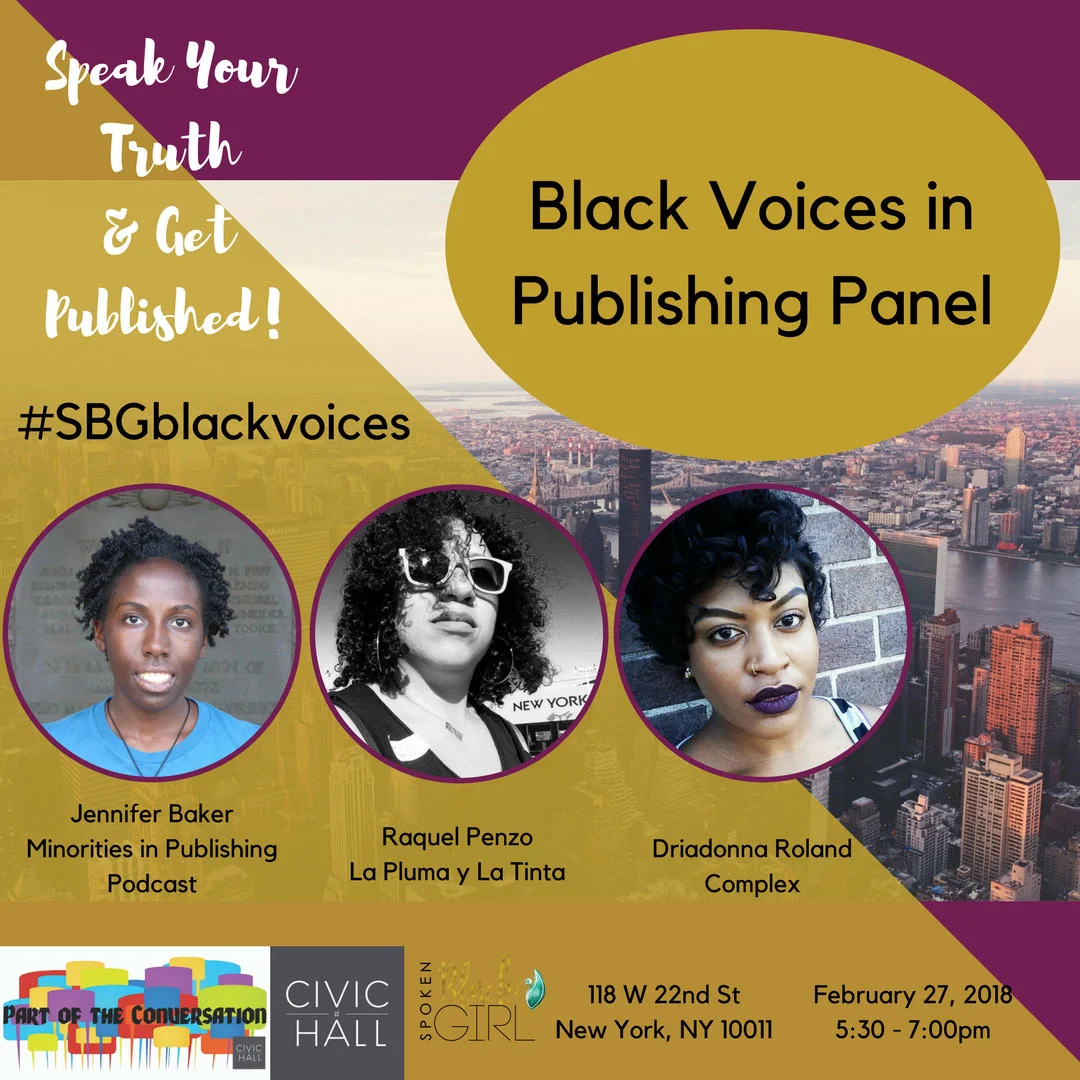
Spoken Black Girl Mag's #BlackVoices in Publishing Panel
Yesterday evening I had the pleasure to be part of the first Spoken Black Girl magazine Black Voices in Publishing Panel at Civic Hall. We had a great time and it was livestreamed on Facebook (see the Source link below)! I have come to learn that I use many many hand gestures when I speak. Never have to worry about that on my podcast, so we learned something.
Anywho, thanks to all involved especially Tamika for doing the AV, Rowana for organizing, Driadonna and Raquel for being brilliant and all who attended. Hope to see more of these to come to encourage PoCs in publishing!
The Politics of “Nice” as a Black Woman, Doing Advocacy Work, in a Social Justice-y Arena
I was telling a podcast guest this just yesterday: There’s very little that I won’t say to someone’s face. This is a positive and a negative. I haven’t always been this way but the more you know, grow, and learn, the less you may be inclined to play by certain rules you feel are destined to make you a performance artist in your everyday life.
I was telling a podcast guest this just yesterday: There’s very little that I won’t say to someone’s face. This is a positive and a negative. I haven’t always been this way but the more you know, grow, and learn, the less you may be inclined to play by certain rules you feel are destined to make you a performance artist in your everyday life.
You know the image of the two faces? Specifically the one used for theatre: one mask smiles widely, the other frowns on the verge of tears. That’s what I mean. I also like the phrase “tears of a clown” or “laughing through my tears” to express that dichotomy of pain and either a semblance of hope or one on the brink of mania.
Back in my teens and 20s I was pretty damn obedient. (Obedient is the best word I can convey in this instance.) I was “obedient” in that I rarely if ever disclosed my concerns publicly and especially to people in authority who may have been the issue. I always went to my confidants and we bemoaned our lives as assistants working unpaid overtime, willingly though not happily, too nervous to say anything. We were taken advantage of for hundreds of dollars by our publisher, inciting this kind of work ethic that to get ahead and be respected was to show how much you would do for free before being compensated in any way. Now, I cannot say this is tied to my race or even my gender so much as I noticed many of us (white, Black, male, female) going forward with this seemingly known fact: We weren’t worth it. Now, take that into other realms of your life where maybe not money but time or at least presentation is taken into account. Where you see bits of yourself being chipped away in public or private and you take it day by day. You don’t want to say anything, particularly if you’re a Black woman in my case, because you don’t want to be that person. (I had a friend/former co-worker who refused to eat Popeye’s at the office because she didn’t want people to smell her fried chicken and assume she was a ghetto Black person.) This is how deep these representations go. We have to be dainty, polite, articulate, even in the face of problematic comments and engagements. It’s exhausting. We have to be nice. When a man touches me on the street I should’ve been “nice” in my reproach of his advances. When a boss yells at a vendor but says you cannot use a “tone” to express your dismay, instead be “nice.” When someone who has openly said something racist says, “Well, if you’d said it a different way I would’ve listened” meaning you have to be nice. Even when a problem arises our approach to trying to squash it needs to be calculated and plotted out like a friggin’ novel.
The issue of niceness is one that is forever embedded in every aspect of our lives and as a woman of color it’s a big part of how my life is expected to be molded around other’s expectations but also feelings. (Exhausting.) I am not a politician for a reason. If I were a politician I’d like to think I’d be the Maxine Waters (or Shirley Chisholm) of politicians, asking direct questions and brushing off inane comments about my hair to keep focus on the facts of the situation. Dodging ridiculousness at every angle to say, “Can we focus?” But she’s also had a much longer time in politics to say “I really don’t care” and while people, like myself, are as invested in her message and how she handles herself for her constituents, I can guarantee before this hype and even after she has been told time and time and time again that she needs to consider how she looks to others, that she could be a bit more “subdued” or “kind” in terms of someone else’s ego. I can totally see one of her fellow congressmen or woman saying: “You may wanna tone it down a bit, Maxine. More people would listen if you said it in a nicer way.” It’s an expectation and weight put on people, particularly the marginalized, unfairly and it’s not only the majority and men who thrust this at us, it’s also those within underrepresented communities.
I’ve been told I’m respected because you know where the wind blows with me. My face doesn’t hide much these days and I push not an agenda as much as the necessity to think and ask questions. I can react pretty quickly but when it comes to how things are handled I can also be very deliberate before making a decision because I want to know everything involved to make an educated guess. My barrage of questions, I have been told, “makes people feel bad” or “stupid.” This is not my problem. One’s inability to fully formulate a plan then present it to others for involvement means people, like myself, want to know what we’re getting into. This has no bearing on feelings or one’s emotional stability. This is about facts and facts alone.
Within the social justice arena some have made a profit off of being blunt. That is their brand and platform, but it’s not safe for all of us to pursue that path because of obvious reasons. Some women of color shroud or mix this honesty with humor to make others feel better about listening. There’s a reason why we hear the same voices spout thoughts that those in the marginalized community have said years ago, however when they pounded the desk and shouted it into the rafters it becomes a gif gone viral rather than someone who is attacked by trolls with no recourse for defense in their own home.
Within social justice as within any other arena the work is about others but that doesn’t mean politics are not involved nor does it mean the expectation of niceness is dormant, it’s ramped up there as well. For all the times I’m told I’m well-respected, I’m also given the cold shoulder for being that verbose and that honest. It’s not my brand so much as it’s how I live my life. Games are exhausting, they take a certain level of dexterity and mental skill. If I want to play games I’ll open up my Mahjong or Tetris or Food service app and sweat it out.
Being honest (i.e., for some reason not synonymous with nice) doesn’t mean rudeness by default. It means, requesting that someone say what they mean and mean what they say without concern for relationships so much as a determination to be on equal footing. If you said you want more marginalized writers I expect you to stand by that. If you say you would consider me for something, I’d hope you meant that because I will follow up. If you say you hear the calls and issues of those around you, I’d really want to see that you’re following up on this. If you say you hate seeing Black bodies discarded by police brutality then I expect you to speak up on the issue when it arises in your sphere, not remain silent. If you say that you’re learning from your mistakes and yet, and yet, said mistakes arise again and again and defensiveness comes up then it’s showing that this was lip service, not an eagerness or real determination on one’s part to be better. It means you want your kudos for reciting the right script and not going beyond that. You can be “nice” and be a horrible person. You can be brutally honest and a good person. These things are not mutually exclusive no matter how much people want to believe in the easy, yet flawed, categorizations of good vs. evil or hero vs. villain.
№45 is not a nice person nor is he nice in how he comes off and yet, and yet, he’s the leader of the United States. Do not act as though being “nice” is all uphill in terms of how one lives their life or what their successes are.
It’s taken work for me to get to a point where I’m comfortable with being as honest as I am. I still have work to do in various areas but in this I am good as long as mutual respect is given. I don’t chase, I don’t drag, and I don’t do petty/high school back and forth. If you want something, say it. If you feel a certain way, be open about it. If you need time to consider where you’re coming from, take that time. Fact is people go ghost rather than reflect. They get into arguments, presenting their CV of work done without accounting for hurt caused. They will go into their feelings without ever reflecting on others or the larger issues. They will take a paycheck for one statement and never do any further work on self nor learn the institutions that have gotten us to the place we are now and continue to be. This is a problem and time and time again “tone policing” continues to pop up as a reason to not listen, to not adhere to certain values, to not consider others in what goes on behind the scenes or in front of the mic. It’s a problem everywhere and it’s disconcerting when it’s also an issue in regards to work to better this world let alone ourselves.
I’m up for critique as is everything I do. No need to mince words but also not to just blurt out “I don’t like it!” If someone asks my opinion I give it, but I may dole out certain things and not others based on our relationship or lack thereof. I may abstain from speaking all together knowing I cannot give someone what it seems they actually seek. I cannot continue to be “nice” for the benefit of someone else if it puts me in a position of discomfort or the words being used against me when I didn’t inherently mean them. It’s a play I don’t like participating in, so I choose not to. When it comes to what I say I tell people this:
It’s not literary theory, it’s philosophy. Don’t try to read between the lines of what I said, read what’s there. It’s right there.
My goal is to be good, not “nice.” Perhaps the work we do and the world will learn the difference.
Read the Fine Print: The Pawnee Treaty, Perception, and Questioning Rather Than Accepting “Truthiness”
Making my way to the next landing I saw the largesse of an oil painting of the Pawnee Table Creek Treaty of 1857 by William Haskell Coffin. In this painting, Native American men dance in an open field wearing nothing more than headdresses and loincloth of sorts. Some carry hatchets, others spears. The settlers, all white, stare stone faced, dare I say questionably, at those in celebration. The imagery itself disturbed me knowing the broad strokes of the history between colonialists and Native Americans (short version, the first group steadily massacred the second).
On a table to the far right of this painting was a copy of the actual Pawnee Treaty of 1857. If the visual didn’t incite pause, the treaty itself had me stupefied.
Yesterday, on an uncharacteristically pleasant day since I arrived in Nebraska, I decided to go to the local park. Going further I figured I’d swing by Arbor Lodge mansion, heralded by locals. A little bit further and I ended up inside, purchasing a ticket to roam the 50+ room home that housed the family of J. Sterling Morton (his eldest son may be known for Morton Salt fame and his youngest of Argo (corn)starch).
The place has three floors, not including the basement where the restored bowling alley is; it’s a lovely renovation with a teal lacquer to the walls I wish was in my own apartment. Making my way to the next landing I saw the largesse of an oil painting of the Pawnee Table Creek Treaty of 1857 by William Haskell Coffin. In this painting, Native American men dance in an open field wearing nothing more than headdresses and loincloth of sorts. Some carry hatchets, others spears. The settlers, all white, stare stone faced, dare I say questionably, at those in celebration. The imagery itself disturbed me knowing the broad strokes of the history between colonialists and Native Americans (short version, the first group steadily massacred the second).
On a table to the far right of this painting was a copy of the actual Pawnee Treaty of 1857. If the visual didn’t incite pause, the treaty itself had me stupefied.
Words like “civilized” were used as were a lot of promises with the caveat that, at any time, the President of the United States could come and take it away. There wasn’t so much fine print as there was blatant print detailing what the Native Americans who would be “civilized” by the new Americans would receive and also the terms to which they needed to agree. They would need to send their children to school to make sure they learned the ways of the immigrants. They would have white people on their land in certain industries the new Americans felt they needed to know. They would receive materials “not to exceed” a certain amount (that came up often) as though they were being bestowed a favor. The first line of Article 5 sums it all up pretty well: “The Pawnees acknowledge their dependence on the Government of the United States” — translated it’s a different form of peonage signed 8 years before the abolishment of slavery.
Now, I’m not getting into a further debate on whether this was right or wrong for the Pawnee Tribe to sign. Strife didn’t stem from the new (white) inhabitants of the country solely, but from other tribes as well. What I am getting at is that when the treaty was right in front of my face for me to read and decipher on my own that I could see how messed up the terms were from the start. How condescending and righteous these clauses were. It reminded me a lot of what the most recent head of U.S. office as well as his Republican predecessor said about people overseas. That they needed to be cultured; that they needed to learn our ways; that by giving us their land, usurping power, we were helping. Their followers, be they willingly ignorant or thinking themselves incredibly profound jumped on that thinking bandwagon. I considered the consistent danger of receiving summaries of our history to have someone else surmise the main point. The way that Arbor Lodge, and in particularly this painting, along with the treaty itself were celebrated made me shiver. But in all honesty, several years ago and I’m sure in many other instances for various other groups, I remain unaware of the larger trials and the pitfalls of trusting others who do not see you as completely human.
I’m finally reading The Underground Railroad which probably exacerbated or further inspired this thinking. That is a book that should make white people uncomfortable, however, I’m also confident that many reading the book of the white persuasion don’t see themselves as the depraved slave owner but as the kind-hearted abolitionist helping slaves to their next stop to freedom, willing to take the blows themselves if they were in such a situation — though thankfully they are not. I wonder if the people working at Arbor Lodge, two very nice, older, bespectacled white women understood the issues of this presentation. Yes, the treaty was available, plain for anyone to see, read, and infer their own thinking, but there’s also the labeling of it as a celebration. Who, exactly, are we celebrating in this instance?
I don’t know if it’s so much a spoiler as much a plot point, but in Underground Railroad Colson Whitehead depicts the lead character Cora in one of her first stops on the railroad line in a new job she was thought to be perfect for: performing slavery behind glass for museum visitors. What’s noted by author and protagonist is the dulling of the horrors of slavery itself, the performance of it. Putting actors in a space constructed by non-slaves, nor are they slave owners, not exactly, to recreate the horrors for intrigue but also educational purposes. That the slave ships to the slave cabins is bad but this is a thing of the past, aren’t we a grand nation now?
I haven’t taught children in more than a decade, having no tenacity for it on a long-term basis. But when I was in school, public, higher education, the classroom was about deciphering but also absorbing. “Sure, whatever you say teacher,” in regards to the symbolism in Moby Dick or Emily Dickinson or Huckleberry Finn. If you can’t explain what you see then it isn’t there. Fair enough. But there was also the case of: If you don’t see what I see then it’s inaccurate. This leads to a poor state of affairs. Those that question are considered questionable themselves. Children will speak when spoken to. My mom’s favorite: Do as I say not as I do. (Plot twist: that didn’t work on me past a certain age.) When I teach, or better yet lead workshops, I teach editing. I encourage looking at things with a finer tooth comb, questioning choices not because you’re choices aren’t reliable but because we have to dig deeper. It’s part of my job in publishing. I think if it weren’t for my role as a production editor, copyeditor, proofreader, looking at inconsistencies and inaccuracies daily, I don’t know that my education in academia alone would’ve propelled me to the point I am now.
I’d love for those who oppose the water protectors at Standing Rock and many other sites to read the Pawnee treaty to start. The flippant nature in which people on Twitter — where everyone has balls behind an avatar — saying this group had their chance. That Native Americans have “plenty” of land. They were given gifts, so why not appreciate it? When they say these things out of malice as well as ignorance I’m going to send them the Pawnee Treaty of 1857 and ask them to read it in full and say, honestly, if they’d agree to these terms. Scrutinize it the way you would a mortgage loan. This isn’t the same as my landlord saying, “I’ll give you a dishwasher costing no more than $150 dollars but also at any time have the legal right to rescind this offer whenever my mood calls for it.” This treaty was a bad contract, the kind an agent or legal mediator would come in and say, “Mofo, don’t sign that we have to go to negotiations.” The U.S. wasn’t looking out for the interest of anyone but the growing government and a select class of citizen. Read it, read it and tell me that this document showcased a concern for Native American citizens rather than the proliferation of gluttonous capitalistic ideals. If you think so, I have a 52-room house to sell you.
The #SupportWNDB Campaign! It's All the Rage These Days
The #SupportWNDB campaign has kept me a tad bit busy these past few weeks (and for the coming weeks until it ends). And if you haven't heard about it after it trended on Twitter here's a bit of background on the initiatives of We Need Diverse Books.
Yes, yes, yes. I have been delinquent in posting. Almost a month! My apologies. One of the things that have kept me busy (beyond end-of-the-year deadlines) is the We Need Diverse Books Indiegogo campaign that started October 24th. As a team member and social media person I've been helping on that end and it's been go, go, go!

It's also been fantastic to witness the support online as well as in dollars and donations that people have been providing for their belief that We Need Diverse Books (WNDB)! Being part of the WNDB team has been so great. Everyone is very committed to the belief and pitches in. It's a family as much as it is a team and I am very honored to have been asked to be a part of it after SCBWI. (Thanks, Ilene!)
So what is #SupportWNDB? Where is the money for this campaign going? Well lots of initiatives but focusing on providing grants to emerging writers as well as established diverse writers (there are other diversity grants via SCBWI--which I won last year--and Lee & Low [New Visions & New Voices Awards] as well as the Speculative Literature Foundation) but We Need Diverse Books wants to add to that and not relegate the sole aspects of diversity to people of color.
There's also diversifying classrooms via partnerships with An Open Book Foundation, NEA, and First Book to bring diverse authors for school visits at disadvantaged schools; educational kits for librarians and educators on how to diversify literature offered and dispensed to young readers; in addition to funding the 2016 Diversity Festival we plan to have in Washington, DC! So many things and plans ahead to promote diversity and changing the course of thought for what is considering "mainstream."
As a writer of color this is something I believe in not only in terms of being an emerging diverse artist but being a reader who would've loved to see more diversity in what I read as a kid and clamor for it as an adult no matter what the genre. I very much believe and am happy to give my time and money in #SupportWNDB and I'd urge others to also.
So that's one reason I've been busy and if you'd like to find me I'm more than likely behind the @diversebooks account on Twitter. :o)
The Diversity Debate
The lack of diversity in books specifically has had a snowball effect since BookCon's lack of White, straight, male authors on a panel that could've easily contained people of the non-majority. Since then more statistics and essays and posts and cries for diversity have been provided in print, online, and spoken about at conferences (not just in private discussions). The "debate" of diversity is not going away and that's a good thing.
There’s been a lot of discussion about the lack of diversity in art. In my world this pertains to books specifically. The discussion has risen and will not be curbing any time soon thanks to We Need Diverse BooksTM and also other entities focusing specifically on bringing more attention to diversity in books--meaning that there should and could be more non-majority main characters (not sidekicks) as well as more diverse writers. Last week Publishers Weekly revealed their 2014 salary survey for the publishing industry that included the option for those who participated to note their race. The results were staggering. Not only in the fact that many people approached did not respond but that of the several hundred who did the reflection of people of color was under 10% total, which seemed to set the online world on fire.
My friend Bev Rivero and I created the podcast Minorities in Publishing (MiP) because with our 20+ years in publishing we had always felt the lack of diversity in publishing. Working in it you cannot help but see it and it’s interesting to me that once the numbers were represented, be it a small portion of those approached in the industry, that more awareness came to light about why there may not be more diverse books being acquired, promoted, and sold. If there aren’t enough people of color (POC), LGBTQI, or disabled helping on the back end of bringing these books into a publishing house, developing a plan, and going on to find readers for this type of material (those without a true understanding of what it may be to be of the non-majority) how can we expect anyone to best stand by these books (and writers) to make work for a larger audience?
Being a team member of We Need Diverse BooksTM, co-creator of MiP, and also a female writer of color I have an investment not only for others in this industry and seeking to be a part of the industry but for myself as an emerging artist. Getting more minorities involved can be beneficial to those of us struggling to tell and sell our stories and if more diversity and representation matches the world we live in why can it not also be reflected this way in art? It’s a long and ongoing discussion with many sides and perspectives. The truth of the matter is there is a lack of diversity and for those who may not see it or may want to brush the lack of diversity off as being because there's not enough “good candidates” or “good material” is a very narrow way to look at it. The onus can’t be only on the person creating or applying. Affirmative action is not meant to get unqualified candidates a job and the request for equality is not intended to inhibit one group over another.
The diversity debate isn’t so much a debate but more a request for others who hadn’t noticed the disparity to take a moment and see what others do. How many books with POCs, LGBTQI, and/or disabled characters in a primary role are on bookshelves? How many are on best-seller lists? How many are reviewed in the outlets that still do review books? How many stories by and about minorities are publishing in literary magazines? How many are promoted outside of the one aspect of it being diverse and not so much attempted to find a broader fan base but focus on the issue of race, sexuality, and/or disability without looking at the person as able to carry a story for them being them?
The “debate” isn’t going anywhere anytime soon. Because of so many advocates and allies and resources available there cannot be any further room for the discussion to be considered moot. It’s not simple to dismiss and it may not even be easy to rectify in the long run either. The addition of more diverse materials still need to be quality materials and applicants for publishing job should be qualified. Yet, there’s no doubt that on both sides this is available and perhaps needs the nurturing that it is not getting. “People want to see themselves in books” has been quoted many times over and will continue to be said. We want to see ourselves in what we read and watch, and we want to see ourselves as not “other” but as part of the norm.