Baked Good Spotlight: The Maple Bun

I usually hold my baked good reviews for end of year, but since this one is too good to hold and is in another state I figure I should spread the word to my loyal followers (all five of ya!) now. For the past 9 days or so I was in the lovely Green Mountain State (Vermont to the rest of the world). I was there for the Postgraduate Writers' Conference (PWC) and then for some extra time just to hang near Burlington.

Well, on Saturday PWC organizers scheduled in some time in the morning to go to the farmer's market in downtown Montpelier. So, I went, treading down a big hill (and then back up the hill later), to see what their market was like.

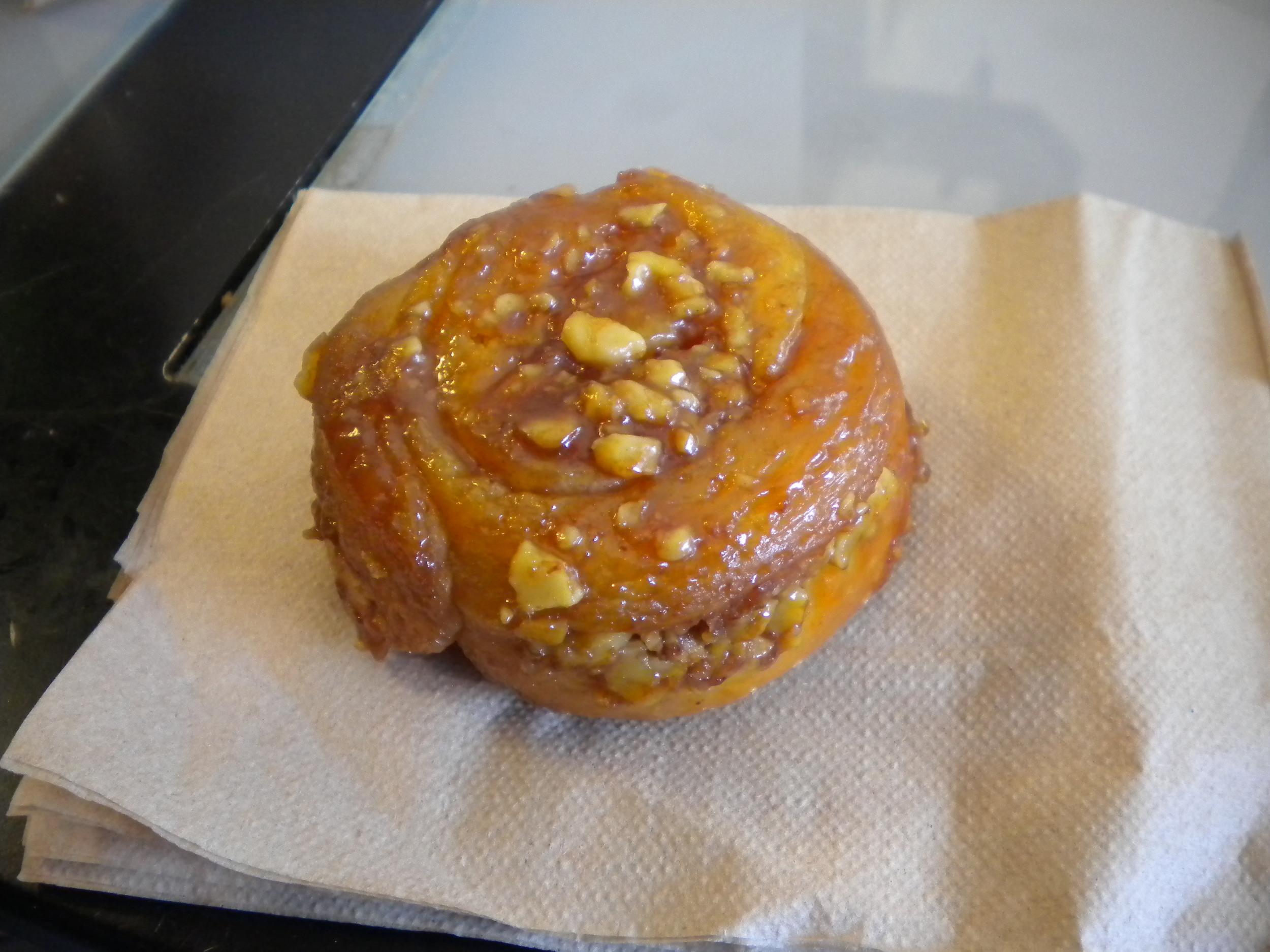
We got there as the market attendees were setting up and it was Vermont natural products galore. If you like food, this farmer's market was for you. I ended up replenishing my supply of maple sugar and syrup and passed by a booth for a nice bakery called Red Hen. I saw they had a lovely good called the maple bun and even though it had raisins in it I purchased it and then hoofed it up the hill in time for my workshop.

Well, an hour or so into workshop I dug into my paper bag, inhaled a lovely maple aroma, then took a bite out of this bun. My workshop leader (and conference director) asked as I chewed if I got the Red Hen maple bun. I nodded, enamored. "Isn't it the best thing in the world?" she asked. I agreed with another nod as I simultaneously took another bite.

Well folks, from there on out it was love. My husband came to pick me up and whisk me off to S. Burlington the next day and I told him about this lovely bun. On our way out of Montpelier we happened to pass Red Hen Baking Co. How crazy is that? And I said I wanted to go there the next day since we had time to kill and he likes to get his driving in.

Fast forward to the next day when I introduced my husband to the maple bun. We were lucky to get the last one of the day after 12pm. (Yes, those babies sell out fast!) And, I guess needless to say, he fell in love with it as much as I did. The maple goodness is slathered all over the bun and topped off with chopped walnuts. The raisins inside are sparse. The most I had in a bun was four and those were easy enough to pick off.

I called early the next morning to order a half dozen and we made our way back to Middlesex, VT to get ourselves some buns to take home. The idea was to share with others who'd appreciate it, but since supply is low (they make a set amount per day so you really should order ahead of time or just get there early) and I can just be plain greedy when it comes to baked goodies we hoarded the bunch for ourselves. On the drive back home I kept looking back at the box of buns, our precious cargo. We got home safe and sound, buns intact and I had one for breakfast this morning. They're even better warm!

So, I urge you to take a detour on your travels to or through Vermont to visit the town of Middlesex and more importantly get in on some maple bun action.

Red Hen Baking Co. makes their goods on-site everyday! So get a nice sandwich with avocado mayonnaise, or a gallon of maple syrup, or a pain du chocolat or any of their freshly baked artisan breads.

If looking at this bun doesn't tempt you, I don't know what will.

Deliciousness personified

Inspiration: Who was yours?

Last month, my first year as a mentor with Girls Write Now ended. At the last reading for Girls Write Now I got to meet author Tayari Jones in person. And she's as wonderful in person as she is talented on the page. In reading her blog I noticed one of her latest entries about MCing the Girls Write Now reading and how she wished she had a program like GWN available to her when she was growing up. This is one of the things that I, and many others, have noted when referencing GWNs mission statement. While the organization was in its premature stages when I was in high school, I know I and many other teenage writers could only have benefited from having a mentor help to push, praise, critique, and educate when it came to writing.

Fortunately, I did have someone who was a constant source of inspiration and was sort of a mentor to me in high school as I wrote and considered writing to be part of my immediate future.

I went to John Bowne High School in Flushing, NY, and was part of their Center for Writing program.  Being a freshman in a school where you know no one is intimidating enough. You want to make an impression, friends, and settle yourself into a niche. Weeks into my start at Bowne one teacher proved to be more interesting (and interested in what us students had to say) than the rest. This woman would become my mentor and motivator. Her name is Janet Feldberg. Ms. Feldberg was one of the more senior teachers there and the advisor for the freshman/sophomore writing magazine Pendemonium. She had a Mother Earth quality about her that made everyone like her. She treated her students like equals, not like kids. She was our educator, but she respected us and so everyone respected her.

Ms. Feldberg encouraged us when it came to reading the classics. As she watched our eyes glaze over in trying to recall the metaphors of Moby Dick or the characterizations in The Great Gatsby, she never showed frustration just encouragement. And in doing so with analysis of text she also encouraged us when it came to the creation of prose.

As a teen I was really into R.L. Stine's Fear Street series and also tagged onto my mother's fascination with Stephen King. Yes, I read The Babysitter's Club and Sweet Valley High, but I saw myself writing things that went way deeper than that and by deeper I mean my stories were meant to make readers laugh and scare the crap out of them.

I submitted my first story, "Terror at Bowne," to Ms. Feldberg with few expectations. Yet, within a day she pulled me aside and thought it was a vibrant story. It starred my best friend, a couple other friends, and myself as we realized our freshman year at Bowne was not what it seemed. There were monsters afoot! Perhaps one could consider it an allegory for the way teenagers feel when they start at a new school alone that they picture the worst happening and find camraderie with others when bad things come to play. But at the time, it was just fun to write. The villain of the story was a disliked history teacher who refused to allow her name on the page. So Ms. Feldberg offered to become the "terror" and published it in Pendemonium that year. I remember when she read it aloud in one of our computer writing classes and the response it got from my classmates. They were engaged even rooting for the ending. It was then I realized I probably had a calling when it came to this whole writing thing.

Over the years Ms. Feldberg continued to praise and help me with my work. When I attempted poetry, inspired by Dickinson and auspiciously mimicking her voice Ms. Feldberg understood what I was really talking about after weeding through the imagery and metaphors and earthly comparisons. She praised another poem I wrote based off a prompt and encouraged me to be an advocate for the CFW program at Open Houses. She was happy to read a sequel to "Terror at Bowne" and again offered her name as the villain who rose from the grave. She was my biggest supporter in those years and as I moved on to run the student government and worry about budgets and advertising and keeping a student body inline, my writing began to lose its importance in my life.

As I worried about SATs and scholarships and placement exams I couldn't focus on writing a sequel to the sequel of "Terror at Bowne." But I had come to Bowne to be a writer hadn't I? What was keeping me from that? Not having Ms. Feldberg as my instructor in the last two years of school (she mainly taught the freshmen and sophomores) definitely had an impact on my creative side. I was focused on the tasks at hand: dances, decorations, meetings, representation, speeches, scholarships, senior prom, a part-time job. And as the last two years of school hit me with the responsibilities of post-adolescence I realized I missed my mentor. I missed the encouragement she gave me my first few years there to become confident enough to run for student council president, to write essays on Stephen King and consider his work as interesting as the tomes being thrust down our throats, to read deeper into books and consider what made them part of a literary canon and why there were so important for us to read in the first place. Nope, as juniors and seniors we lost our guiding hand in the resourceful, kind, and patient Ms. Feldberg and were greeted with people a bit gruffer, sterner who expected us to be prepared. We weren't kiddies anymore, the kiddies had Ms. Feldberg and in a way I envied them for that.

As I prepared to leave Bowne and pursue a degree in writing I remembered everything she did for me. I remembered all the inspiration she gave me and mostly I appreciated it. I remember her writing enthusiastic letters of recommendation for my college applications and running to her to let her know I'd succeeded in getting into my first two choices.

A couple of years after I graduated Ms. Feldberg retired and became a grandma full-time. I saw her a couple times and wrote to her, but this was before e-mail became an institution in most homes and we lost touch.

As the year for mentoring ended I couldn't help but be reminded of Ms. Feldberg and realize how much she not only influenced and inspired the writer I've become, but also the person. I notice the way I've gone about teaching and being a mentor for young girls is almost synonymous with how she approached us freshmen when we sat still and anxious in her class. I realize we both approach students/teens with encouragement and respect. That when we meet young people they need to know that they're capable of anything and it all comes down to desire.

Yes, I'm getting nostalgic in my old age, but did want to take a moment to thank Ms. Feldberg (albeit virtually) for all her guidance and inspiration then because I wouldn't be the person I am now. I can't help but wonder what life has in store for the mentees that leave Girls Write Now. But I hope, whether they realize it now or in retrospect, they appreciate the guidance their mentors have to offer because not everyone gets a Ms. Feldberg in their lives.

NYC French Macaron Crawl!

My friend organized a French macaron crawl in New York City last month and we tried about a half dozen places offering different varieties of that lovely confection.

Read more

Book Expo 2010: Still in the Big Apple, but on a smaller scale.

This was probably my fifth or sixth time at Book Expo of America (BEA) at the Jacob Javits Center. I first heard about Book Expo when I was in college and got the opportunity to volunteer in the autograph area where I met many authors of various genres. It was my first time being exposed to the largest book convention in North America, and I liked it. I volunteered through my Alma matter a couple more times in the autograph area as long as BEA was being hosted in New York City. (It used to change its location every year rotating between New York City, Los Angeles, and Chicago.) As of 2009 it was announced that Book Expo would remain in NYC until 2012, which made me extremely happy that one of the largest conventions would continue to be in my backyard, so to speak. As of late I've been part of the press attending Book Expo and am glad not to volunteer. While I enjoyed the busy-ness of BEA and being part of the staff and having access to areas many others didn't, I also realized that not working allowed me more time to browse and see what the conference was actually about.

Book Expo has always been about introducing new authors & titles to a wide audience as well as garnering additional press for established/best-selling authors. Sometimes illustrators are also present. Librarians come to Book Expo to learn of the new titles they may want as do booksellers. Educators enjoy Book Expo for the opportunity to find new literature to stimulate students and themselves. Book lovers come to BEA because, well, BOOKS! And the exhibitors of big and small/international and domestic publishers,  typesetters, digital publishers, literary agents, Newspapers, and new writers come for contacts and to bring notice to what it is they do.  Book Expo has always been a great place for those with a strong love of books and realize how much they can inspire and entertain.

This year, Book Expo wasn't as I remembered it. And it made sense that in economic hardship one would notice how much the publishing industry was affected as well as the convention itself. Last year, Book Expo was the way I always experienced it, bustling; filling two floors with most publishers around and hawking as many galleys, ARCs (advance readers' copies), published titles (successful and new); food samples for cookbooks; samplers as intros to their books; beer & popcorn (just cause); and so on and so forth. Yes, we were in a recession, but apparently people hadn't been hit hard, yet.

This year BEA was condensed to one floor; there were less giveaways of books, galleys, and so forth and the giveaways that were available were timed early on. Many co-workers I saw in late morning or early afternoon expressed disappointment at the slim pickins. I informed them that had they been at Jacob Javits at 9:01 am they might have gotten some choice stuff.  The autograph area and in-booth signings have always been a key source of getting some nice titles, but many people aren't keen on spending most of BEA standing in line. The press room last year was bountiful with food (muffins & bagels in the morning, cookies & brownies in the afternoon) all the while having coffee and tea readily available. This year the press room had limited offerings. Only a pitcher of coffee and tea respectively that did not get refilled and also a plate of brownies and cookies and a large serving of lemonade in the afternoon, these "amenities" also did not get refilled once supply dwindled to nothing. In exchange for less treats the press did get internet access and computers to use to constantly update their news wires, but I did miss the snacks to nosh on in the midst of running around from booth to booth, talk to talk, or meeting to meeting.

Some big name publishers, like Scholastic Inc., didn't have booths just meeting rooms and were not giving away galleys or ARCs to the public from a booth and had limited author signings in the autograph area. Last year Macmillan went that route, but this year had a small booth and did a limited number of signings. Many publishers had smaller booths which accounted for the available space on one floor.

The autograph area of about 30 signing tables or so was brought upstairs to the main hall, as was the Children's publishing pavilion (section dedicated to children's publishers solely). Because of the newly condensed conference this made for some heavy traffic throughout. Add on the limited amount of giveaways and people churning for anything they could get their hands on (title, subject matter be damned), in addition to long lines for in-booth or autograph area signings and you had yourself on heck of a traffic jam! The space between the autograph area and booths was smaller, causing the booths closest to the autograph area to be blocked off for their own signings or advertisements and patrons to just be all-around confused as they tried to find their author of choice. For some big ticket items like Melissa Marr, Kate DiCamillo, Sarah Dutchess of York, Mo Willems, Louis Gosset Jr., and so on and so forth lines started early and so you had a growing line behind a line extending to the exhibitor area and blocking who knows how many tables.  I've had the pleasure of working in the autograph area and with Dave Holton who manages this section and it can get pretty hectic when people want to make sure they see James Patterson or Carol Higgins Clark or Teresa Giudice from The Real Housewives of New Jersey or just want a really nice cookbook. Some people get snippy, others full-on irate, some give up and just ask if you can give them a copy of the books sans signature, others may see a friend and skip the line thinking no one the wiser. And you have to be the one to try and keep the peace and maintain order. Not always easy on a summer day in a packed conference hall.

One of the big themes at BEA this year was Going Digital! There were many talks about the future of e-book publishing, how publishers can try and garner more interest in e-books, and authors being more open to the possibility. Some authors, mainly Scott Turow (author of Presumed Innocent and the recently published sequel Innocent) was vocal about worrying about the copyright and safety of the author's work when it came to e-publishing. How safe are e-books anyway? This is kind of the same position musicians first took when their music was available online. How can one monitor where your music is going and if you'll get compensated for it? The truth is no one has a good answer for that one. So it seems this debate may go on and on and on. After reading a review of this talk from Publisher's Weekly daily review of Book Expo it was interesting to learn that publishers wouldn't necessarily make all books they published available in e-book form, mainly high profile authors (aka guaranteed bestsellers) and mid-tier books they have high hopes on. Indie publishers can't even think of going digital right now what with their book lists being small in general as well as their budgets. So knowing that some obscure authors or new authors may not even get a chance at having their books available online kind of hammers home the point of how important print books are as well as libraries and heavy promotion by the author.

The daily review from Publisher's Weekly also noted that international companies were not too fond of the shorter week. Before, the conference was Thursday-Sunday. With Thursday being a day of press events and the keynote address officially marking the beginning of the conference, as well as set-up for exhibitors. The conference would officially be open to all Friday-Sunday for meetings, exhibitions, giveaways, and formal talks to the public about the theme as well as more pavillions dedicated to various genres. Last year had an African-American pavillion which also offered around-the-clock meetings and one awards ceremony in celebration of this specialized genre of literature.  Whereas this year there was no advertised celebration of African-American literature or Spanish literature per se beyond a talk or two on the meeting floor. This year Tuesday was the day for press events, leaving Wednesday and Thursday for meetings and the official opening of the exhibitor floor. International publishers/companies were upset that they lost a day for meetings as not everyone was allowed on the exhibitor floor on Tuesday. Many wanted a refund for the day lost. Some booksellers weren't keen on the new format because Monday-Wednesday tend to be big days for signings in their stores and attending Book Expo took away from their availability as well as authors and, potentially, attendees who may be at BEA and not want to visit bookstores after a full day of books, books, and more books (in addition to achy joints from standing in line for all those tomes.)

While I was disappointed this large conference was on a slightly smaller scale and in the middle of the week rather than on a weekend, I did enjoy my time there. I didn't mind standing in line for books I was really interested in and in the mean time met a lot of nice authors and  patrons. I was big on story collections this year and every author I met was interested in starting a conversation and was glad to hear how excited you were about their book. Some authors like Kathryn Stockett, whose book The Help became a NY Times best seller, basically signed and smiled to keep the long line moving. While waiting in line for her book we did get a nice caramel cake straight from Mississippi where the novel takes place. I got to tell Scott Turow how much my mother loved Presumed Innocent. I got to let the authors of Going Rouge know how intrigued I was by their book after reading about it in Entertainment Weekly and learning that one was on "The Insider" and how much we found the show to be a bit disconcerting. I got to learn more about the background of  Tony O'Neill author Sick City and a genuinely nice guy. In the midst of waiting for autographs I got to meet a woman from the Midwest who loves The Hunger Games series as much as I do and a bookseller from New Jersey who kept referring good books to me by saying: Holy shit that was a good book! I met a teacher who was basically asking every publisher if they needed a lawyer for her daughter a new graduate from law school while collecting as many collectibles as she could. And I met author Lutishia Lovely, who also had a penchant for cookbooks as she and I met in line after line for certain titles.

Next year Book Expo will retain the current format of a shorter conference, mid-week from May 24-26, 2011 in NYC. While I see the ups-and-downs I cannot foresee ever not enjoying a conference that celebrates books so intensely. Each year I feel an immense sense of luck at being exposed to so much in a few days.
Writing groups & workshops can be really helpful…if you find the right one.

Writing groups, workshops, or getting insight from people you trust are all necessary in the artistic process of writing. No matter the genre or the scope it's important to have a critical eye look at you first draft (or drafts) and help you flesh out your novel, story, poem, personal essay, etc. Definition A writing group may be just that: a group that writes together. Or it may be a group that writes together and critiques one another’s work within a session. The basis of a workshop is that the entire session is dedicated to appraising each other’s work. It’s important to differentiate the two in your mind and decide what you may want in terms of help with finished pieces or just a push to write on a consistent basis.

Atmosphere Writing groups and workshops are overly available and not, which is a Catch-22 of sorts. Mind you there are many groups/workshops out there full of "writers" but not necessarily writers with a critical eye. From high school on I've been in workshops and among people that vary from being overly analytical of your work (If you’ve never done that how can you write about it?) to not giving a damn because they aren’t serious (This class was supposed to be an easy A.) or just want to get as much feedback as they can for themselves (Enough about me, what do you think of me?). When you hit the jackpot and find not just one, but several people in a group who are outgoing and help you tackle the problem(s) in your manuscript it can be the best thing ever. When you experience those who just don't know what it is they do and don't like about your work, people who go on to focus on simple things like the overuse of one word, or simply say “I liked it” can make you downtrodden.

I’ve experienced good and bad writing groups/workshops in and outside of the academic environment. Students in my undergraduate and graduate courses were not “in the know” in regards to proper workshop etiquette and would either blatantly bash your work or roll their eyes at the thought of it or remain mute throughout the semester. In a smaller writing group outside of class things may be better or worse. Perhaps you have a thick skin and want to hear every last issue with your piece or maybe you want people to handle you (and your work) with kitten gloves therefore you need to hear the good along with the bad, preferably in that order. In the real world, with no instructor acting as mediary/Yoda there’s even more of a chance that people won’t stick to their guns about attending group regularly or providing feedback as there’s no threat of a bad grade on one’s transcript.

Etiquette For those of you who may not be familiar with the workshop environment here are some tips:

1)    Sharing means caring  Everyone has a story to tell, so try to be polite and professional when attempting to critique another writer’s work. Sharing one’s work isn’t an easy thing to do and to be bashed by people you may or may not know can hurt the ego. So be kind and try to acknowledge the good and bad of a piece to show you care about the work itself and seeing it progress. Example: “I enjoyed the visuals in this piece and how much you made me feel in the moment as a reader in the first few pages. I completely saw the environment I was in in 1920s Mississippi. I did think there was a bit too much description at times and would suggest cutting certain parts. For instance...” 2)    Don’t be afraid to speak up if something doesn’t make sense – Some may gloss over the points they don’t understand and just focus on what made sense to them in a piece. This can hurt the author because they can’t see what you as a, hopefully, objective reader can. After rewrites and plotting the author is so connected to the piece they may not see the glaring holes that you do. So if there’s anything that didn’t strike you as clear make sure to mention it and not worry if you may be the only one that missed something. Example: “I’m not too familiar with The War of 1812 so there were aspects of the battke scenes I couldn’t get into fully. Maybe you could be a bit more descriptive of the lay of the land and the machinery used then or add footnotes to certain things for those who may know to skip and those who don’t to take a look at?” 3)    Multiple reads are a good thing – When writing a formal report sometimes you re-read portions of the work your focusing on to get a clearer sense of what you’d like to say about it. The same goes in a writing group/workshop. What you may have missed the first time around you may suddenly see in the second or third read. Or you may notice elements of the story that don’t work upon an additional read. I’d suggest reading a piece at least twice before providing feedback to the author, more if time and length of piece allow. 4)    Keep an open mind – Many of us have our favorite genres. Some love science fiction and fantasy while others abhor it. Some love chic lit, others prefer literary fiction, some literary non-fiction, some historical books. We all have something we prefer over something else. Yet in a writing group (unless it’s focused towards speculative fiction, sci-fi/fantasy, YA, erotica, etc.) we have to be open to all sorts of genres. Just because you may not read YA doesn’t mean you won’t be able to provide suitable feedback to a member in your group. If character development is off or the setting isn’t clear than these are things that can be helpful whether you’re a fan of the genre or not.    Example: “I was really into this. The narrator is funny and brought me right into the plot with his acerbic wit. Some of the more technical aspects of what makes speculative, speculative and not solely sci-fi I may be not know, but as a story I am entertained and would continue reading after the first few pages because I like the characters and setting.”

Of course, there may be times when you really cannot get into the work because you’re just not too into the genre for specific reasons (language seems too artistic and not focused, reminds you too much of Virginia Woolf and you can’t stand her) this is also a good time to mention you’re not the reader for this person’s particular style and can note the reasons why. Either way you’re helping to provide the author with some feedback as to who their audience should be, in which case this also helps them to know to narrow things down when submitting pieces to magazines or agents. Example: “I’m sorry. I tried reading it and it made me a little uncomfortable because of the heavy religious undertone throughout. I thought it was well written and held the main argument in the piece. But also felt it was kind of biased, so I’m afraid I couldn’t give it a fair read as you may have wanted. I just don’t think I’m the reader you may be reaching out to in this piece.”

The Good and the Bad There are writing groups that are open call and some that tend to interview participants before allowing them to enter the arena. In the case of the latter it may be a payoff because you know that the interview process is routine and that others have been through the same thing. Knowing a group takes applicants and their work seriously can only be a plus. I would warn one to be weary of groups where no meeting is necessary and one just throws their work into the fire. It’d be best to meet with members first, see how they treat one another and critique, then make a firm decision.

Something else to be weary of is writing groups with friends. Like everything in life there can be a good and bad side to this. I became friends with writers I met at an international writing conference. When we returned to our respective homes I got in touch with those in my area and we decided to meet monthly and discuss each other’s work. Since it was established that we were serious enough to pay through the nose to go overseas for a writing conference it turned out to be a positive meeting of the minds locally. On the flip side, I’ve attempted writing groups with friends of mine I knew wrote and these get-togethers were more happy hour hangout sessions than writing/critique sessions. Plus, friends may flake out more than those you don’t know because they expect you to understand. Hell, you saw your friend just last week at karaoke, you know what the deal is! This can make things murky so that the excitement in the beginning drops off slowly then steadily once other things get in the way. In these cases if you have friends who are serious pin them down, now. If it’s easier to just do some e-communication with them to get feedback on your work and vice versa this may be the route to go.

Move Forward Just because you may not have anyone with a critical eye to readily look at your finished draft(s) doesn’t mean you should pump the brakes on your writing completely. Continue to progress and proceed with other work. Heck, it wouldn’t hurt to give a piece a rest for a bit if you’ve been living with it for months or years before taking another crack at it. Let the manuscript marinate!

But in the mean time, be on the look out for writing groups/workshops in your area and see what they’re about. You might even consider going for a graduate or post-graduate degree to focus more on your writing and meet published authors that can give sound advice. Just. Don’t. Stop. Writing.

Here’s a list of places you may be able to give and get feedback on your writing: $ denotes fee

Online Writing Groups/Communities Critique Circle EditRed.com FanStory.com Goodreads Book Excerpts group Gotham Writers Workshop – Offers some free and fee-based courses online or in-person.  ($) Mediabistro – Offers online and in-person classes/workshops. ($) Mike’s Writing Workshop Online Writing Workshop The MuseItUpClub Critique Group Scribophile.com ($) Writer’s Digest University (formerly Writing Workshops Online) ($) The Writers Studio

Workshops/Writing Groups Asian American Writers Workshop Craigslist - Every so often someone may post searching for writers to join a group in the Writing section. East Harlem Writers’ Circle (NYC) - Become a fan on Facebook! Freebird Writing Workshops (NYC) ($) Gotham Writers Workshop (NYC) – Offers some free and fee-based courses online or in-person.  ($) List of Latin focused writing groups Mediabistro – Offers online and in-person classes/workshops. ($) Meetup.com – May list some writing groups/workshops seeking new members to meet regularly in various locations throughout the US. Morningside Writers Group (NYC) - Offers workshops in fiction, memoir, speculative fiction, and screenplays. ($) 92nd Street Y (NYC) Unterberg Poetry Center Writing Program for poetry and fiction workshops. ($) NYC Latinas Writers Group - Become a fan on Facebook or a friend on Myspace! NYC Writing Coach – Editor provides one-on-one help and workshops. ($) New York Writers Coalition New York Writers Workshop ($) The Sackett Street Writers’ Workshop (NYC) ($) The Writer Magazine list of Writing groups (USA) The Writers Studio

Also try:

Local colleges/universities – Beyond workshop classes for degree students colleges/universities may also offer workshops for continuing education students. Alumni may be searching for people interested in starting a group on or off campus. (Here are a few places offering free writing courses online.)

Various writing conferences, residencies, and week-long (or longer/shorter) workshops go on across the country (and world) throughout the year. Poets & Writers has a list of residencies and conferences or you can try ShawGuides or Google ones by genre/location. You can apply for financial aid for many that are connected with colleges/universities or apply for grants you may already have from school or fellowships.

OR you can form your own group/workshop by placing an ad or conferring with friends (serious writers need apply!).