
BLOG
Interview with Caits Meissner (spoken word artist, graphic artist, lyricist, and all-around mellow lady)
Interview with artist Caits Meissner who is a New York City educator, spoken word poet, graphic artist, and musician.
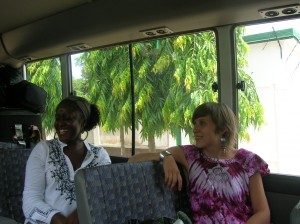
I met Caits Meissner when we went to Ghana for the first year of the Pan African Literary Forum in 2008. Caits won a scholarship to attend for her phenomenal poetry and I was hankering to go to Africa and use up some bonus money. We were both there for the ambiance and the guidance of a great roster of instructors and authors, and we enjoyed our time immensely.

I have kept in touch with a handful of people from PALF and am certainly glad that Caits is one of them. She's a teacher, artist (in various genres), and gentile soul who's work will simultaneously inspire and astound you. I've heard her live and heard her audio and seen her graphic work and am consistently blown away. (Definitely check out her website(s) and follow her for upcoming gigs.) I was glad she offered to do an interview for her friends with blogs and she has inspired me to do a rotation of interviews with friends who are artists in their own right and want to spread the word about themselves.
~~~~~~~~~~~~~~~~~~~~~~~~~~~~~~~~~~~~~~~~
JBH: As an artist, how do you deal with the constant changes in media and social networking? Do you feel face-to-face is dead or as a spoken word poet do you feel you get to engage in meeting people more through performances than perhaps fiction writers and non-fiction writers and so on and so forth?
Caits: What a relevant question! My students, sometimes, when you ask them what their interests are say, "the internet," or "facebook." This fact frightens me, but I am not immune to it. I find myself "plugged in" too often and it accounts for a lot of disconnection in my own heart, despite the facade of intimacy. Its also a great way to be heard, so, like all things in this great life, its a balance. Unfortunately, I have never been much good at balance. I have a plugged in community, so I keep fairly up-to-date with the latest tech invention but its overwhelming. And exhausting. And I find myself less able to focus and lose myself in my art the way I was able to as a kid, with parent-limited 'net access, and a slower than syrup dial up connection. These days, I write a little, check my phone, write a little, check a blog, constantly checking in. Who wants to troll the internet for accolades and mentions constantly? Who wants to pump themselves to their friends and supporters over and over? The trick is detachment from an already detached networking system, and its a sincere practice in this day and age.
The good thing is, as a performer, I do feel connected to the larger world in a very tangible way, being on a stage. There is a direct contact: a handshake, a wink, a hug. But there is something very special, I still think, about being behind a pen and paper. You maintain a certain old-world mystery. I say embrace that. I waffle between wanting two very sharp distinctive worlds: being known and celebrated, and hiding, running away.
Caits: I struggle with this question, deeply. There are moments in the past when I would have loved to answer this question, ranting and raving and grinning. It defined me. These days, I am more acutely aware of what hard work being in front of a classroom is. How much energy you must give to the young faces in front of you. How unkind they can be and you take home the day like an old coat and dust it off, patch up the holes, put it back on and walk back into the wind. I shared this sentiment with a close friend, also a teaching artist, who said, "the amazing thing is, even when you aren't trying, young people are the center of your world when you teach, even if you teach part time, and there is a beauty in that." I agree.
Teaching becomes the center of my life, whether or not I wish my focus was more on myself, my love, my art. Teenagers demand a certain level of patience and attention and it becomes a very real meditation. Sometimes you wait weeks for a breakthrough, but when it happens, nothing is sweeter. The students I teach, for the most part, are not artists by their own definition. They find it difficult to be free in their expression and are afraid to create "wrong." Teaching reminds me there is no wrong. What a victory it can be to pull the creativity out.
Caits: I love this question! I am pretty good at sharing how much I love someone's art with them and I am blessed to have crossed paths with many of my old and new favorites. Of course, there are some that I just haven't... met, or written to, or expressed to. My friend Dionne Lee (look up her photos! Wowee.) has been writing to her favorite artists and getting amazing responses! She has been urging us to write to our influences and give them our love. I'm going to choose two women I'd love to gush to. Let me get to tell them now:
Dear Ani Difranco,
You saved me at thirteen. Seriously. In every way. Let me open for you.
Love, Caits
Dear Miranda July,
You remind me I can make all the art I wanna, in all kinds of ways. Thank you for expanding the boundaries of what my heart believed was possible for an artist. Thanks for destroying the box.
Love, Caits
~~~~~~~~~~~~~~~~~~~~~~~~~~~~~~~~~~~~~~~~
Caits: Of course! I have a big, baaaaddd website at http://www.caitsmeissner.com and I keep a daily blog at http://caitsmeissner.tumblr.com I tweet sometimes, too: http://www.twitter.com/caitsmeissner
Thanks, Caits for tackling these questions and for sharing your work, your kindness, and influences!
"Coming to America": A Classic Piece of African-American Cinema
In watching "Coming to America" again as an adult I was able to appreciate the nuances of characters and plot development, something, when looking at current African-American films, is often lost on the screen. In the midst of all the genres of film and in looking back at how original African-American film was only ten or twenty years ago, it's amazing to find that so few films are original, daring, and intune with society or smart enough to know how to mock it.
Yesterday, my talented writer friend Kim invited me along as her guest to another talented writer's birthday party. Tiphanie Yanique's birthday was a nice celebration in Clinton Hill, Brooklyn at a lovely African restaurant that provided the entire back room for her celebration.After dining on some lovely Senegalese food and massive pieces of equally delicious red velvet cake with Tiphanie's face on it, we got to enjoy a movie projected on a white screen hosted by QUE Films. While a QUE Films original was set to air the men behind the project decided on lighter fare. So, we saw Coming to America, one of Eddie Murphy's more successful films and, to me, one of the best African-American films of the past twenty years.
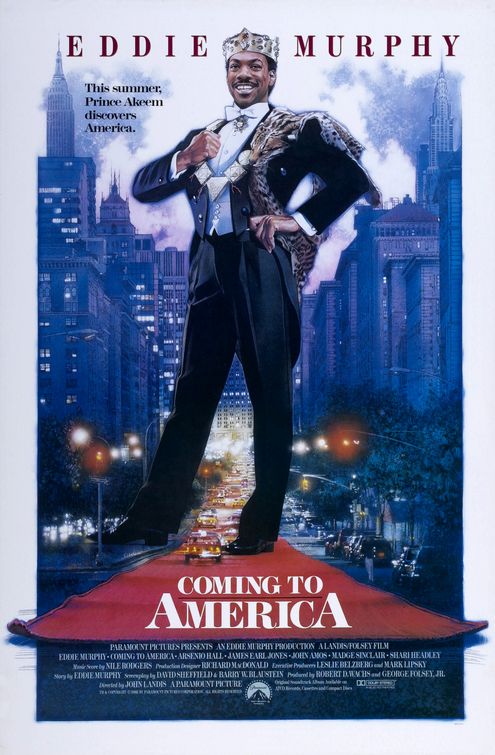
It was funny that a conversation Kim, me, and another poet we met at PALF had was that when seeing things later in life you interpret them differently. I have maintained that I enjoyed and understood Huckleberry Finn in graduate school more so than I did in High School and the opposite can be said for my take on Catcher in the Rye. But in watching Coming to America again, years after I'd viewed it before and many years after I originally saw it cut/dubbed on television I saw a lot of what Murphy was attempting to portray in Black America and what he made riffs on (the story was originated by Murphy while the screenplay was written by David Sheffield and Barry Blaustein).
Coming to America was released when I was seven years old, in the summer of 1988. Eddie Murphy was riding the wave of being the most influential and powerful African-American actor of his time and was coming off a string of hits such as Trading Places and Beverly Hills Cop after having been a central and popular player on Saturday Night Live. In Coming to America one of Murphy's key talents (impersonation) is shown throughout the film in energetic and hilarious characters. Murphy has always had a talent for getting into different characters and adopting mannerisms and voices and we've seen this in several movies of his (including The Nutty Professor and Norbit).
When looking at the kinds of African-American films that are currently released you can pretty much put them into a few of categories: Caricature Comedies (see: Soul Plane, Lottery Ticket, The Cookout, many Tyler Perry movies, etc.) where Black people are played as the over-the-top stereotypes they're supposed to be showing their varied enough not to be, Crime/Action (see: Dead Presidents, Belly, Cradle to the Grave) where a Black celebrity (many times a rapper seeking to cross over) will do a quick action flick with someone who is a staple in this genre (see: Steven Seagal, Jet Li) and make a few bucks at the box office. But then you also have Inspirational movies (see: The Gospel, Tyler Perry movies), Independent Dramas that don't always get the recognition they should for being so versatile and intriguing (see: Eve's Bayou, Precious), some Family Friendly films (see: Roll Bounce, Johnson Family Vacation, College Road Trip, etc.), a few Musicals (see: Dreamgirls), and of course we can't forget the wonderful, and not so wonderful, Biopics (see: What's Love Got to Do With it, Malcom X, Ali, Get Rich or Die Trying, etc.). Something like Hard-hitting films mainly refer to films of the past that were ahead of their time like Boyz n' the Hood, Straight Outta Brooklyn, or Spike Lee's earlier work (Do the Right Thing, Crooklyn, Mo Better Blues),
In the midst of all these genres and in looking back at how original African-American film was only ten or twenty years ago, it's amazing to find that so few films are original, daring, and intune with society or smart enough to know how to mock it.
The popularity of Tyler Perry films have a formula: Woman is scorned by evil man and is destitute for part or much of the film, finds a wonderful man in the least of all places, and boom finds strength in herself as well as the ability to trust/love again. It's a formula that works and it's one in which Black women do not see themselves often portrayed on the big screen. So, Perry has found his niche. He's the man writing for women and women love him and men think he's pretty darn funny when he wants to be, especially as Madea. Perry isn't necessarily taking cultural norms and turning them on its head, he's taking cultural norms and consistently providing the audience with a happy outcome, no matter what (though I heard there was some tragedy in the sequel to Why Did I Get Married? daring him to go against type for just a bit on-screen).
When looking at other recent films with Black actors at the center they are either part of a mixed cast or the token person of color (see: Denzel Washington who can pretty much play and do whatever he wants in Hollywood as well as Halle Berry who is attractive enough to do whatever she wants in films) or if the cast is largely Black then they are an all-stars (Lottery Ticket, Death at a Funeral) to ensure high traffic at theaters, yet not necessarily guaranteeing a solid story and/or script or is an Independent film you may not hear about unless Oprah backs it or funded it herself (see: Beloved, Precious) and then there are many other films by Black female directors you may never hear of again or ever, one of my favorites is Kasi Lemmons). 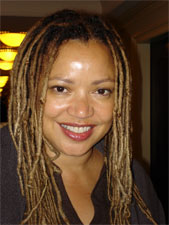
So what's my point? Well, in looking back at Coming to America I realized how different it was in a time when African-Americans didn't have a lot of control over the images they played. In this film Eddie Murphy made Africa look superior to America! A rich prince with wealth beyond his dreams, flower bearers, people looking after him in every-which-way and attending to his every needs was unhappy, even though he had jungle animals roaming through his front yard and fresh fruit galore! When he comes to Queens, NY to find a bride he is surrounded by filth, destitution, and a lot of expletives, yet he has never been more content in his life. His cohort is played by Arsenio Hall, a man so pampered he finds everything appalling as his comrade finds things to be so wonderful and new. The audience may be relating more with Hall initially, but eventually finds that they sympathize with Murphy's character. Murphy's Prince Akeem is the flipside of Cinderella, the prince seeking the fair maiden and having nothing to go one but his wits and instincts, having to trump jeri curled boyfriends and nitpicky fathers and a lustful sister. This film could've been done with an all White cast. I could see Matthew Broderick or Matt Dillon fighting over the part of Prince Akeem, though he'd be named Prince Albert back in the late 1980s. Instead of going to the slums of Queens, they may have resided in Manhattan and attempted to understand the subway system and other "quaint" American customs. But that's another film all together and wouldn't have been as relatable, at least to me as an African-American female, as Murphy's film was.
Coming to America mocks Black culture, but also embraces it. The four men in the barbershop (two played by Murphy and one by Arsenio Hall) are the best in cinema! They argue about who's a better boxer and the state of the world today. They know the world as they've watched it go by them steadily and mock it day in and day out. Murphy shows that the father of his love interest is an entrepreneur wanting to make his fast food restaurant, McDowell's, as big as McDonald's! He has an African-American female who wants to do good for her community, while being good and finding good in other people. Coming to America shows characters that are a bit saucy like your local, sweaty preacher ogling girls in bikinis at the Black Awareness rally while preaching the Lord's name at the same time. Murphy's main character brings wealth and kindness to those that didn't receive it in the ghettos of Queens and is continually a better person for it.
Now, I'm not saying Coming to America is the end all/be all when it comes to African-America cinema. Yes, there are better films out there, but I think this is one of the best films by African-Americans for African-Americans and that there's been a steady decline in ones that make you realize how much is packed in and what the writers, actors, crew, and director are trying to convey. Coming to America is a coming of age story as well as a love story...with African-Americans in it! This movie shows that African-Americans are hard-working, sexual, intelligent, neurotic, egotistical, and kind. The characters played off characteristics we're familiar with as viewers, but made fleshed out characters for many of the people playing them. Yes, the preacher was a bit one note, but he was familiar. Sure, the jerky (jocky) boyfriend of the sweet girl reminded me of many of the jerk/jocks in John Hughes films, but he ended up getting his in the end and realizing that looks aren't everything. Yes, the prince was more spectacular than any woman could imagine, but he had his flaws and insecurities too when it came to finding love.
I think that when viewing a film where the majority of the cast/crew is African-American that we should really look and listen to what's going on on-screen and see how characters interact with each other and convey themselves. Eddie Murphy is a master of physical inflections and such as mentioned and he does a great job of showing how his characters feel. When was the last time you saw a film with African-Americans that made you really consider how much thought was put in behind the meaning of every nod, tear, embrace, kiss, etc? When was the last time you saw someone's face run the gamut in two minutes flat? When was the last time you saw a film that trumped your expectations with a Black cast? It's been a while, you say? Perhaps we should look back in the archives a bit and see what filmmakers were doing twenty plus years ago and urge the up-and-comers to follow the footsteps of finding the unpredictable in the predictable rather than recycling tired parodies solely for entertainment. There's nothing wrong with entertainment of course, but I think in the canon of Black film there should be more thought-provoking ones than ones that simply make you giggle.